Coyote
Hunting Page
Last Updated:
07/19/2015
On This Page

GREETINGS FROM Varmint Al.... I am a Life member of the National Rifle Association. I like to hunt, fish, play with the computer, and operate ham radio. I go deer hunting, coyote hunting, squirrel hunting, and trout fishing every chance I get. I have 2 Black Labs, Bart & Tide and one Chocolate Lab named SusieQ. During pheasant season we hunt most every day.
 Relentless 365
California's Premiere Hunting Magazine.
Relentless 365
California's Premiere Hunting Magazine.
Coyote
Sunrise by Heath Ward
Struggling Varmint Video
Download.
by Dick
Wendell
 Calling
Coyotes
Calling
Coyotes
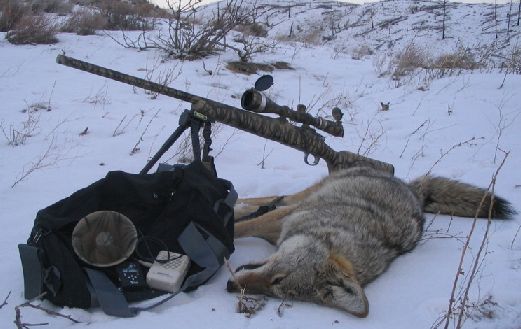
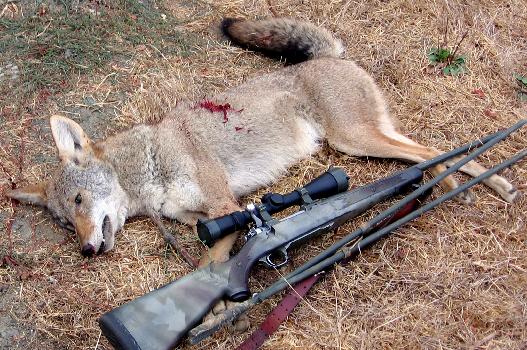
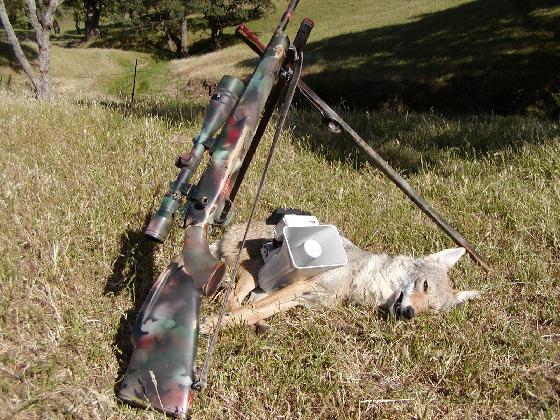
MY CALLING.... Since I started calling for coyotes near Antioch, CA on three large cattle ranches, not a single cow or calf has been lost to the type of predation seen here. My deer and coyote rifle is the 243 Win on a 42+ year old Sako Forester action with a Shilen stainless steel barrel and a "tight neck" chamber, shown below. The scope is a Tasco TR 4-16xAO mounted with Warne rings directly to the grooves on the action. This is as solid a scope mount as I have seen. As you can see below, the rifle and scope are painted camo. There is more about camo painting your rifle on this page.
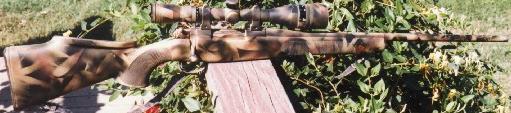
Varmintus maxus camois

Coyote Calling Techniques with
Sounds
The sounds are computer quality
 FREE COYOTE CALLING SOUND DOWNLOADS.... These following
sound files are free with no strings attached. Use them any way you
like. I made them for your predator calling enjoyment and to
promote the Second Amendment. Each new coyote hunter who learns
hunting and buys a gun will more than likely be another supporter
of the Second Amendment. These sounds are not the very best
quality, but as good as I could do on a computer. Each single sound
file lasts about 60 seconds. The sequence sound files are longer
duration. If you burn the sound on your own CD, or MP3 player, I
would suggest 2 minutes of silence before any sound starts and 1 or
2 minutes of silence between each calling sound. You can also burn
the first sequence at a lower volume so as not to spook any close
coyotes. Right click on the file name and select "Save Target As".
Let me know how you like them.
FREE COYOTE CALLING SOUND DOWNLOADS.... These following
sound files are free with no strings attached. Use them any way you
like. I made them for your predator calling enjoyment and to
promote the Second Amendment. Each new coyote hunter who learns
hunting and buys a gun will more than likely be another supporter
of the Second Amendment. These sounds are not the very best
quality, but as good as I could do on a computer. Each single sound
file lasts about 60 seconds. The sequence sound files are longer
duration. If you burn the sound on your own CD, or MP3 player, I
would suggest 2 minutes of silence before any sound starts and 1 or
2 minutes of silence between each calling sound. You can also burn
the first sequence at a lower volume so as not to spook any close
coyotes. Right click on the file name and select "Save Target As".
Let me know how you like them.
ONE BIG ZIP FILE.... All of the calls below, including the 16-min and 20-min Sequence files have been zipped into one large file. Download here: allcalls.zip (35.929Mb) and save the file to a new folder. Unzip the file to a folder of your choice.
These sound files have been recently (2/12/6) re-mastered with the volumes normalized and converted to MP3 in FM quality. Each sound file lasts about 60 seconds.
HAVING TROUBLE DOWNLOADING?.... Assume you want to
download Group Howl (group2.mp3).
Here is what I suggest you try:
1. Right Click on the hot link (the underlined name of Group
Howl below) of the file you want to download.
2. When the menu appears select "Save Target
as..."
3. A Window will appear "Save As" and the default
location is "My Documents". If you Click on the
"Save" tab the sound file named group2.mp3 will be
downloaded to your My Documents folder. Your hard drive now
contains the file.
4. To play the downloaded file, open your My Documents
folder and Double Click on the file named
group2.mp3.
5. To copy the file to the clipboard, you Right Click
on the file name group2.mp3 and select copy.
6. To copy the file over to your MP3 player you need to plug
the cable from your MP3 player into the USB port of the computer.
If you are running Windows XP a window will open and you select
"Open folder to view files" and Click on OK.
Put the mouse pointer inside the MP3 player's folder and Right
Click. Select paste from the menu. The group2.mp3
file should then be written to Secure Digital card in your MP3
player.
 Excruciator
(excruciator-16-min.mp3) A 16 minute sequence of Chris
Butcher's Excruciator call. Starts with 1 minute of silence. 15.1Mb
Note: I removes some of the clicks that I had overlooked in the
recording.
Excruciator
(excruciator-16-min.mp3) A 16 minute sequence of Chris
Butcher's Excruciator call. Starts with 1 minute of silence. 15.1Mb
Note: I removes some of the clicks that I had overlooked in the
recording.
Tiny-Dogs-Chicken
(tiny-dogs-chicken.mp3) Two Chihuahuas chasing a chicken.
Added the chicken squawking. Sounds good.
Tiny-Dogs-Barking (tiny-dogs3.mp3) Two
Chihuahuas barking scared at Bart & Tide with Tide moaning
1.023Mb Its not a standard sound, but its worth a try. Coyotes
should at least be interested and come for a look at the commotion.
Tiny dogs in urban areas are a favorite food of coyotes.
Read-Head-Woodpecker
(red-head-woodpecker.mp3) Coon Skinner recorded it from a
live bird and emailed it to me. Thanks Coon Skinner.
Snowshoe-Hare-Distress1 (Snowshoe 2-1-1.mp3) Snowshoe Hare
Distress sound by Randy.
Snowshoe-Hare-Distress2 (Snowshoe 2-2-2.mp3) Snowshoe Hare
Distress sound by Randy.
Bird Squeaker (bird-squeaker.mp3)
Made with the squeaker out of one of Tide's squeaky toys 970KB
Rodent Squeaker
(rodent-squeaker.mp3) Made with Tide's squeaky toy -
different cadence 875KB
Group Howl (group2.mp3) group coyote
howl with 3 different calls mixed with the new software 944KB
Group Howl (group3.mp3) group coyote
howl with 4 different calls mixed with the new software 944KB
Chicken Distress Call
(chicken.mp3) with the Haydel call 656KB
Woodpecker Distress Call
(mybird2.mp3) with a Lohman Quail Call #115W BIRD
1.316MB
Coyote Challenge Bark
(challenge.mp3) with the Dan Thompson Red Desert coyote
howler 645KB
Coyote Greeting Howls (dthowl.mp3) with
the Dan Thompson Red Desert coyote howler 646KB
Coyote Greeting Howls
(dthowl2.mp3) with the Dan Thompson Red Desert coyote howler
with more chatter 944KB
Coyote Hurt Pup Distress Call
(hurtpup2.mp3) with a diaphragm call 660KB
Jackrabbit Distress Call
(jackrabbit.mp3) 657KB
Cottontail Distress Call (weems.mp3)
with a knockoff Weems call 659KB
Cottontail Distress Call (weems2.mp3)
with a knockoff Weems call 906KB
Jackrabbit (jrpc1.mp3) with the Johnny
Stewart PC-1 Call 896KB
Jackrabbit (jrpc1lv.mp3)
Low-Volume with the Johnny Stewart PC-1 Call 896KB
High Pitched Squeal (highpc1.mp3)
with the Johnny Stewart PC-1 Call 920KB
High Pitched Squeal
(highpc1lv.mp3) Low-Volume with the Johnny Stewart PC-1 Call
920KB
Hurt Coyote Pup (hurtpc1.mp3)
with the Johnny Stewart PC-1 Call 931KB
Utah Jackrabbit (lmuj1.mp3) imitation
with the L&M Howler call 672KB
Coyote Challenge Bark
(lhhcallenge.mp3) with the Loess Hills Howler 694KB
Coyote Howl (lhhowler.mp3) with
the Loess Hills Howler 648KB
Coyote Howl (wileyoneh.mp3) with
the Wiley One Howler 671KB
Hurt Coyote Pup (wileyonehp.mp3)
with the Wiley One Howler 666KB
2-Minutes of Silence
(2-min-silence.mp3) 941KB
1-Minutes of Silence
(1-min-silence.mp3) 469KB
Coyote Greeting Howl
(elkpowerhowl.mp3) E.L.K. Power Howler for a single howl
somewhere in a sequence.
Coyote Chatter Howl
(elkchatterhowl.mp3) E.L.K. Power Howler for a single howl
somewhere in a sequence.
Locater (locater1.mp3) 635KB Clear tone
siren courtesy of Howard Drummond, Fire Crew Capitan.
Locater (locater2.mp3) 720KB Crank tone
siren courtesy of Howard Drummond, Fire Crew Captain.
Note.
The siren locater sound will not call in coyotes but is used to
locate the coyotes. A siren sounds will often cause coyotes
to howl back. You can then tell where the coyotes are located and
come back 30 min or so later and make a calling stand near where
you heard the coyotes howling back at the siren.
ANOTHER PAGE.... There is more info on how I used three of the calling sounds on a couple of coyote calling sessions: Coyote Stand with Pictures and Sounds.
MAKE YOUR OWN CALLING SEQUENCES.... You can rename the calling sounds and the silence files and load them to your MP3 player in the order you want them to play. It is like making a play list. Or you can download Audacity a free, open source software for recording and editing sounds. It is available for Mac OS X, Microsoft Windows, GNU/Linux, and other operating systems. Here is a link on how Audacity could be used to create your own sequence.
20 MINUTE SAMPLE CALLING
SEQUENCE.... Copy the silence sound,
2-min-silence.mp3, into s1.mp3, s2.mp3,
s3.mp3 and s4.mp3 etc. Write the sounds to your MP3
player in the order you want. I was able to put this sequence into
one file using the Magix sound software. Once you start the
sequence, you will have 2 minutes to walk away from the player
before the calling starts. Then it will play the sequence and you
can concentrate on any approaching coyotes without fiddling around
with remote buttons.
Download 20-min-sequence.mp3. 10.563MB 20:34
Min:Sec
s1.mp3
lmuj1.mp3
s2.mp3
jrpc1.mp3
s3.mp3
highpc1.mp3
s4.mp3
s5.mp3
challenge.mp3
s6.mp3
hurtpc1.mp3
s7.mp3
dthowl.mp3
17 MINUTE SEQUENCE.... This sequence starts with 2
minutes of silence then the chicken distress. After 1 minute of
silence it then has the chicken distress with the tiny dogs
barking. The sequence continues alternating and finally ends with
the coyote chatter howl. This should be good for call wise
coyotes.
Download tiny-dog-chicken-sequence.mp3 16.5 MB.
16 MINUTE CALLING SEQUENCE.... This sequence starts at
half-volume with the first sound. I really like this sound
sequence.
Download 16-min-sequence.mp3. 10.779 MB 17:13
Min:Sec
2-Min-Silence.mp3
highpc1lv.mp3
1-Minute of Silence
lmuj1.mp3
1-Minute of Silence
jrpc1.mp3
1-Minute of Silence
jrpc1lv.mp3
2-Minutes of Silence
dthowl2.mp3
1-Minute of Silence
group2.mp3
1-Minute of Silence
hurtpup2.mp3
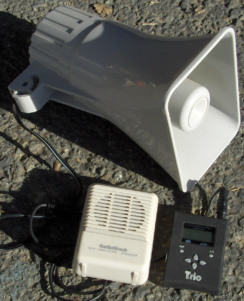
EL-CHEAPO ELECTRONIC CALLER.... I have tried this
combination and it plays the MP3 sound files with good quality and
plenty of volume. The little mini-amp can easily drive the
PowerHorn type speaker with good volume. You will want to mark the
volume setting so that there will be no distortion. The two minutes
of silence is just about right to walk about 80 to 100 yards away
from the caller. A 512Mb Secure Digital card will hold plenty of
sound files. All MP3 players are NOT the same. Some of them will
not play the MP3 files as they were. I have now converted them over
to FM quality and they should work with all MP3 players. The TRIO
MP3 Player works fine and runs on one AAA battery. The Mini Audio
Amplifier runs on one 9V battery. I have used the same set of
batteries for about 6 stands of 30 minutes each and the batteries
are still working. As far as I can tell, the TRIO MP3 Player has
been discontinued. But there are numerous other MP3 players
available. Check the first item listed below.
Note: The almost identical setup is listed on the
Predator Masters Tech Section. It is called The Homemade E-Caller. I was not aware of it
when I put the info together for the El-Cheapo.
Here is an even cheaper build for the E-Caller. See the video here: Wild Enough to Shoot At
Here is a list of the parts: The links keep changing. I have no control over that.
MP3 PLAYER W/ 1Gb MICRO SD CARD AND READER (While they last)
4x6" 50-Watt Indoor/Outdoor PowerHorn
12-Inch Shielded Stereo Audio Cable The cable between the Mini Amp and the MP3 Player. I have heard that the mono cable into the MP3 player sometimes has problems by shorting out one channel and distorting the sound in the channel being used.
All Electronics Corp. Catalog No. PMP - MONO PLASTIC 3.5 MM PLUG. The connector will need to be soldered to the PowerHorn's cable. You can get this connector at Radio Shack when you get the Mini Amp here abut at a higher price.
Note: Above are the places where the hardware is still available. There are many other places where the items may be purchases. Also, the 1GB Secure Digital cards now cost about as much as the 512MB SD cards were priced a few months ago and the 1GB SD card has twice the storage size.
|
A Better
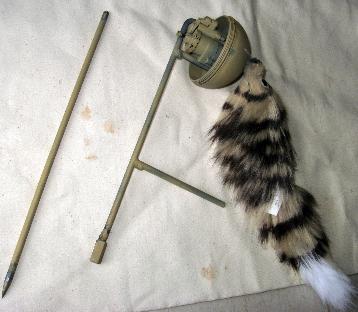
Weasel Ball Decoy by Dick Wendell Al, you are completely free to use my pictures and technique for building this for your website. Your generosity is extended back to you my friend. Note: The reason the action is random is that the tail hits
either the ground or the lower bar. It really makes an erratic
action.
|
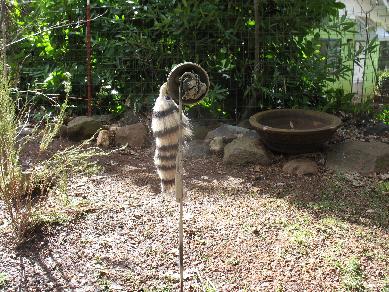
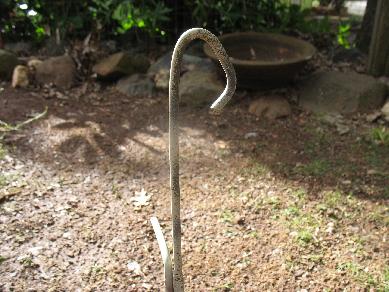
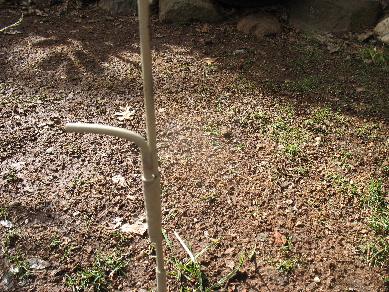
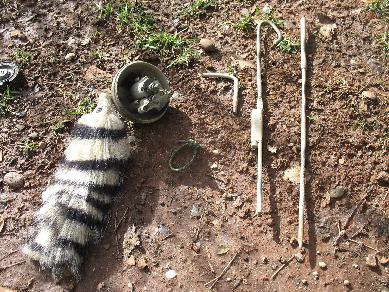
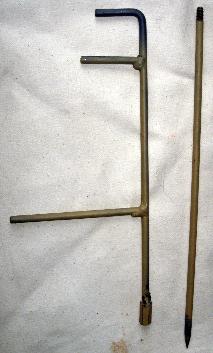
Here is an
easy to construct variation on the Dick Wendell's Weasel Ball
decoy. The random action occurs because the tail hits
the bent bar and then appears to jump around instead of just swing
around like a fan.
Instructions on how to build it are here.
Lee put these videos up on YouTube showing how it works. Good
job Lee
Chastain.
http://www.youtube.com/watch?v=_ThYP80M2eU
More
instructions on building this version of the decoy.
http://www.youtube.com/watch?v=3ltRfdk0Rkc
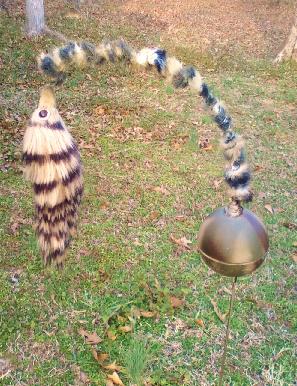
The Wobble
Weasel by Scott Pierce.
Click on
the link above to view the video and instructions on how it works
and how to build it. This looks good and appears to be very easy to
build. Some thin rod, a spring and hot glue. Varmint hunters are a
very ingenious bunch.
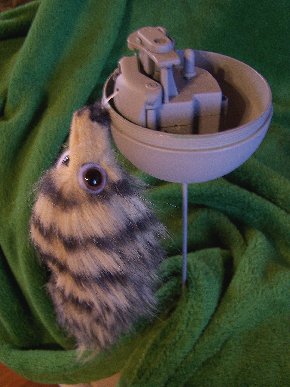
The Hammock
Decoy
Hi Al,
My wife Valinda came up with the ideal to use a Weasel Ball
toy for a decoy. I bought one for about $7.00 at a local toy store.
The problem with it was on un-level ground it didn't roll well and
you couldn't see it over the brush. So when I got home I went to
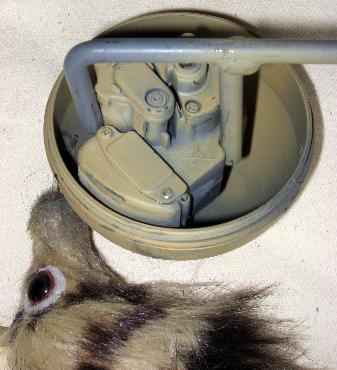
work on it. I unscrewed the cap off the ball to access the motor
this is what I came up with.
1.) Disconnect the tail/Weasel from the ball unscrew ball halves (discard top half of the ball keeping motor half). Motor turns/spins inside ball half.
2.) Take the three screws out of the weight retaining cover on the electric motor and remove the weights (a little pressure with screw driver helps achieve this). This gives the motor more speed yet still allows it to wobble when finished.
3.) Drill tiny hole 1/16 into side of weight retaining cover then screw back to motor.
4.) Drill 1/16 - 1/8 hole in bottom of ball half and glue in a 1/16 - 1/8 steel rod approx 1 - 2 foot long also take a hammer and flatten out about 4 inches of end of rod that goes into the ground to keep rod from spinning (the ball wants to spin the rod so by flattening what's stuck in the ground it keeps the rod from spinning so motor is all that spins) Rod and ball half doesn't spin only motor.
5.) Spray paint the assembly dull gray.
6.) Reinsert tail/Weasel into hole on motor weight cover.
7.) Push steel rod into ground and turn on, it spins the tail and wobbles as well.
Total cost around $10.00 and gives motion as well and uses 1 AA
battery. Please e-mail me back and let me know what you think of
it.
Ricky Hammock
Adairsville GA
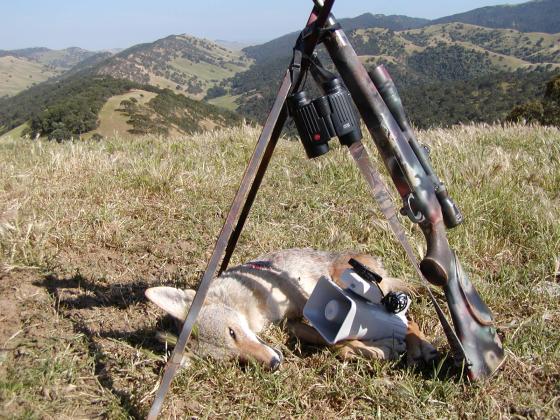
EL-CHEAPO WORKS.... I took the El-Cheapo out for a test run.
The roads are finally open and not mud slides anymore so I could
get to my hunting area. I made two stands with no success. On the
second stand, a ground squirrel was standing up chirping at me. He
was about 100 yards out near the El-Cheapo. After I concluded that
there were going to be no coyote takers, it was time to check the
zero on my rifle. The scolding ground squirrel confirmed the zero
on the old Sako Forester was right on out of a cold clean barrel.
Off to the third stand. Less than 5 minutes into the third stand
here comes a coyote. I saw him at about 400 yards way down the hill
coming through the tall grass. He quickly went behind a rise
heading my way and I was able to setup in the direction where I
thought he would next appear. I was using the 16 minute sequence
and it was only in the second sound (lmuj1.mp3) when I first saw
the coyote.
ON A BEE LINE.... After the one minute of silence between the sounds, the third sound (jrpc1.mp3) starts up and here comes the coyote. He was on a Bee-line heading straight to the call and wasn't looking in my direction at all. At 22 steps from the El-Cheapo, he stopped, broadside, for the fatal 2 seconds at about 80 yards. The 95 gr 243 Nosler Ballistic Tip caught him right behind the front shoulder. I saw him roll once in the tall grass. I let the calling continue for the full 16 minutes hoping for a double, but no other coyote showed. It was interesting to watch a doe and her fawn at about 300 yards. They were my forward spotters and really picked up their ears for each new sound. At one point, they were both looking to the side and I thought there might be another coyote incoming but no show. About 10 minutes into the calling both the doe and fawn stiff stepped out of sight. The coyote was crawling with ticks. It looks like it is going to be a bad tick year. I used Velcro to mount the amp and MP3 player onto the power horn. It works OK.
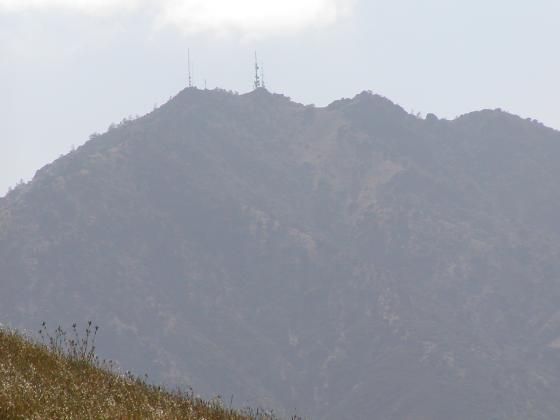
Here is a 10X zoom of Mt Diablo to the West from where I got the
coyote. There is a little haze in the hot air coming from all those
liberals in the San Francisco area. My eyes were starting to itch.
It is either hay fever or I am allergic to liberals. Probably
both.
EL-CHEAPO SCORES AGAIN.... I tried a different location.
This is the place where the old house WAS. It is no more. I will
post a picture of it on the Hunting Stories
Page. I setup just south of the old burned out house. I was
sitting under an oak tree up against the trunk and it dark shade. I
had the El-Cheapo out about 75 yards upwind away from me pointed
south. I had just about given up that no coyote would show. The 16
minute sequence was into the hurt pup call and about done. I was
ready to give up. I glassed the far hillside one more time. This
dry female was at about 250 yards sitting looking in the direction
of the caller. The advantage of having the coyote not looking
directly at you like they do when you use hand calls is really
important. Anyhow, I cranked the old Tasco up to 16X and dialed in
250 yards. I held about 4 inches into the wind on her chest. Bang!
I see her rolling down the hill. That old Sako sure is a reliable
rifle with the first shot out of a cold barrel being right where I
aim. This coyote also had numerous ticks on it. It is going to be a
bad tick season this year. No sign of mange.
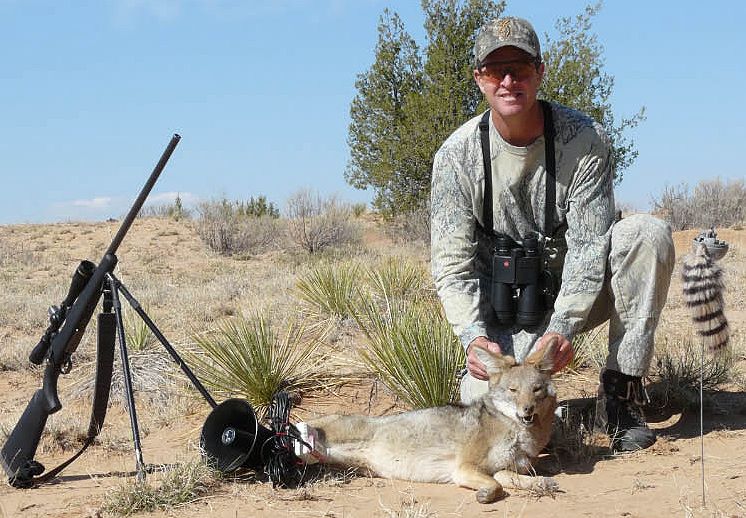
Hi Al! Just wanted to write to you about my first coyote
hunt of the year! The weather has been unseasonably warm here, but
I couldn't wait any longer to put "El Cheapo" and the weasel ball
decoy to their first test of the fall on October 31, 2008.
I made a trip to an area that was great last year, but while
walking to the first stand I was disappointed in the amount of sign
around. The first stand yielded nothing so I was off to make
another. I had just finished turning on the call and returned to my
seat when I looked about 200yds to the right to see a coyote before
the call had even started to run. Well, I figured I'd just get
prone and shoot him. After the shot, all I saw was the coyote
running off unscathed. That's when I decided to sight the gun in at
100 yds, not 300yds. Most of my shooting while calling is at that
distance...I won't make that mistake anymore!
The next stand is in a spot that I just love and have had success
before. It is on top of a juniper-treed mesa with a windmill
nearby. There is a large area on top that has no trees, just some
low cover and sagebrush. I found a dead tree to hang the call on
about 30yds from where I wanted to sit with my back to a juniper. I
put the weasel ball decoy in the ground and turned them both on and
made my way back to the seat. Just after I adjusted my bipod for
the correct height, the call began running the 16 minute sequence I
downloaded from your site. The two minutes of silence is just the
right amount of time to get back and get set-up. Upon the second
sound on the sequence, jackrabbit, I saw a flash off to the right
and up the hill. It was a coyote running in to the call. She was
coming fast and I had to turn a little to the right in case she
decided to stop. I waited until a tree obscured her view so as not
to let her see me move. She kept coming trying to circle out and
downwind of the calling. Coyotes are smart. Before she could get
downwind I lip-squeaked to stop her. She looked right up toward me
and saw the weasel ball. That was all the time I needed to settle
the crosshairs of my Browning A-bolt Varmint Stalker in .243 wssm
behind her shoulder and touch it off. "El-Cheapo" scores again! The
first of the season.
Thanks Al! I love your site and appreciate your willingness to
share your knowledge. Rick Camuglia, Albuquerque, New
Mexico
NOTE: If you want to make a calling series out of these
files or the files on my Coyote Calling Page, here is an important
MP3 file. 2-Minutes of Silence with no
call at all, not even white noise. I made the file by shorting out
he microphone. You can start a calling sequence with silence. This
will give you time to get back to your stand and get ready. Also,
you can put the silence file in between each of the calling MP3
files one or more times so that the calling is not continuous. I
have found that when you burn a CD, you might want to copy the
files and rename each file like Afile1.mp3, Bfile2.mp3, Cfile3.mp3
etc. so they will be in the correct order. Some CD burning programs
seem to have a mind of their own on the order of files it
writes.
Caution: These MP3 sound files could cost you serious money. I take no responsibility for any rifles, scopes, ammo, reloading gear, hand calls, electronic callers, and camo gear you might need if you get hooked on coyote hunting. You are on your own so proceed with caution.
I received this email. As you can see, it is already costing him money.
Varmint Al,
I am just learning and beginning to hunt coyotes. Your website is very helpful. I am 21 years old and from Kentucky. Our family farms so I have access to a lot of good land. I downloaded your calls and made a CD and actually brought in 6 coyotes with it on 3 different stands but I couldn't get any of them close enough for a good shot. But I am hooked!
I have purchased three calls- Circe P1 and P2 (jackrabbit and cottontail) and a Circe Howler #285. I have a few questions as I am trying to learn to use them. I have been reading a lot about coyotes and I think I understand how to set up in a stand but I am not confident in my calling since I have yet to call in a coyote. How can I practice and know my rabbit sounds are realistic? Do you have a longer example of how the Circe calls can and should sound? Does it make sense to use a jackrabbit call since there are no jackrabbits here? The howler is really hard to blow, is this normal or is there a better howler I should buy? Thanks a lot for your time and all the info on your website.
Harry Hendricks
Here is another email:
Hi There,
Just writing to say thanks for the free sounds. My son and I tried them the first time here in Nova Scotia and the Big male coyote actually hit the CD player "twice" on the attack. He was directly under our stand and wanted that screaming rabbit sound but he got the 12 gauge instead. Lots of coyotes around here now. Thanks again and here is a picture of him. Andrew
Another email:
Hi Al, just thought I would enclose a pic of my first coyote. I used the info on your page and built my el cheapo call. Down loaded some files from your page and took to the field. First time out was yesterday afternoon. The call (16-min-sequence.mp3) wasn't even through it's first 3 minutes and this coyote showed up at 328 yds. A 50 gr. Hornady V-Max from my .223 Rem. put her down in her tracks. Thanks for the info!
Mark
Cashmere, WA
Another email:
Dear Al,
I want to thank you for all your advice and the work you put into your website! It has been a great tool and guide for me since I got into fox/coyote calling just a year ago. I live in northwestern Wisconsin. I decided to make the El-Cheapo caller and take it out for a test trial. I made my own calling sequence due to the fact that in our area a fox, coyote, or the rare bobcat around this area may be within calling range. On my very first stand I used a series of three Chicken distress calls with a minute of silence between the distress calls. On the third distress call this beautiful gray fox came bounding out of the woods and on a straight line for my setup. He stopped at this fence line just 65 yards away. My 218 B took the animal humanly and quickly with very minimal pelt damage. Thank you again for all of you hard work and support for all of us out there! Keep it coming! A grateful supporter, Justin Pendleton
Another email:
Hello Al,
Just wanted to write you a quick "Thank You" note for the call sounds I've downloaded from your site. They work better than I could have ever imagined. You have put up such a great site with so much helpful info that I have not even been able to read it all yet, but I will.
I have to tell about my first coyote hunt. I live in Central Ohio and do quite a bit of hunting. Mostly Turkey, Deer and small game such as Rabbit and Squirrel. I've been noticing more and more Coyote and signs of Coyote the past few years so I decided I'd put some time into shooting some of the little Rabbit eating suckers. It's March here now and nothing else is in season so it seemed like a good time to try something new.
Anyway, my neighbor and hunting buddy Bryan and I went out this past Sunday morning for our first try. Bryan owns a Sporting goods/Bait and Tackle store here in town and has some of the store-bought type electronic calls that can be bought. I've downloaded the sequenced sounds and a few of the others from your site. I've made myself a version (slightly different) of the electronic call you have pictured. After playing around with his calls and my homemade one with your sounds we both decided that mine sounded better and was much louder, so we used it on the first hunt.
WOW! That's the best way to describe the action this thing made happen. We got out to a friends 150 acre farm just before daylight. Setup near the middle of the property next to large tree that was big enough to conceal both of our outlines and turned on the call. We had only been there about fifteen minutes when a Coyote came trotting up from a small creek area straight in to my scope view. One shot straight into the chest from the 22-250 at about 80 yards and you can imagine this old male dog didn't do anything but fall on the ground.
I have never hunted anything and had it all happen this quick and easy. What a blast. If it weren't 7:00am I would have been ready for a beer. We sat and called for another hour or so but didn't see anything else. I'm guessing there are more Coyotes in the area but the shot at first one might have spooked them away. I'm going to include a couple of the pictures we took that day. I'm the bigger guy in the picture. I can't say it enough times. THANKS! Wayne Stephens
Another Email:
A year ago I did not know how to call a coyote, and thanks to your info
I just killed my 43rd coyote. Thanks for all your help my deer and
hogs might make a comeback. Regards, Eric Dicke
Another Email showing the sound files work:
Varmint Al,
Just wanted to let you know that I really appreciate your tips, sounds, and advice on your website. We entered into a Coyote Calling Contest and look at the results. Check the attachments. I�m a huge fan. Keep doing what you�re doing buddy. You�re awesome. Please feel free to do what you want with these pictures.
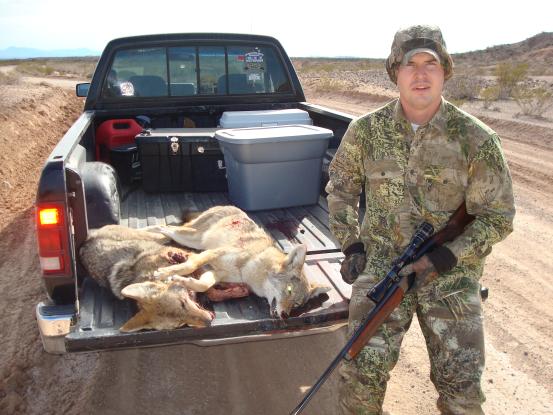
We used your calls that were on the website. Specifically the ones that we used were Jackrabbit Distress 1 and Jackrabbit Distress 2. We entered into a coyote calling contest on the 19th of December. The hunt was from Sun up to Sun down. The limits were a 100 mile radius of El Paso, TX. We could have had a two or three person team. James Wagner and Steven Holden set a team together the night before the competition started and hunted in Sierra Blanca, TX about 90 miles from El Paso.
Out here in the desert there are PLENTY of coyotes to kill. I really think that they are probably one of the most over populated critters around. They will come to just about anything. We downloaded your sounds onto my Foxpro and let them rip man. We had coyotes on our position in 3 minutes or less on 3 different set ups. We even called in a double on a coyote and bobcat. Unfortunately we only got the coyote on that hunt because we didn�t see the bobcat until we got up to pick up the dog. It was an awesome hunt man, and we ended up with a tie for 1st place in the competition. Hope all is well with you Varmint Al. Thanks for your website buddy. We couldn�t have done it without you. Keep calling those yotes.
Steve and James
Note: I made all of the calling sounds on this page myself and recorded them with a microphone and my computer. They are MP3 files. You are welcome to download them, copy them, and use them any way you wish. I made the sounds to promote hunting and just for the fun of doing it. My reward is having more people enjoying hunting and quite likely supporting the Second Amendment. Good Hunting... from Varmint Al
Short free sound files that are less than 5 seconds long:
Coyote greeting howl E.L.K. Power
Howler
Coyote chatter howl E.L.K. Power
Howler
Coyote greeting howl #2 Dan Thompson Red Desert
Howler
Coyote greeting howl #3 Dan Thompson Red Desert
Howler
Coyote greeting howl Dennis Kirk
Howler
Hurt Jackrabbit with Woods Wise with
Vari-pitched howler
Circe Jackrabbit call
Circe Cotton Tail call
Dan Thompson PC-2 rabbit screams
Fawn Bleat with a single reed diaphragm
Challenge Bark with the Dan Thompson
coyote howler call
Hurt pup with the Johnny Stewart PC-1
vari-pitched call
THE CALL.... My favorite call was
the Woods Wise Vari-pitched howler, but the mouthpiece broke. Not
sure they are still selling them. You can get one from Wing Supply
Model No. WW060 or the latest RedHead catalog. You can't make a
decent coyote howl like this with it, but you can make
the most varied hurt jackrabbit to cotton tail calls
with it. Just by biting down on the two halves of the mouthpiece
you can vary the pitch. [Note. The Wood Wise call
finally broke and I can't find another one. I have switched to the
Johnny Stewart PC-1 Variable call and it works just as well if not
better.] Opening and closing your hand around the end of the call
is almost as important as the air pressure on the mouth end. If you
do it correctly, you can almost feel the bobcat's teeth as he is
biting down on the back of the cotton tail. It can be loud or soft
and with the most emotion of any call I have used. A real winner.
It does have one problem. After about 30 minutes of use, the reed
travels down the mouthpiece toward the exit of the call. Then it
gets difficult to make the soft whimpering sounds and takes about
twice the air to use. Just take the mouthpiece out and pry open
from the exit end and slide the reed to the front. I use the back
of a pocket knife blade (while it is closed) between the front of
the two plastic pieces that you bite on. This leverages it so you
can move the reed forward. It is hard to explain with words, but
once you have the call in your hand and see that the reed has
moved, you will figure out a way to move it forward.
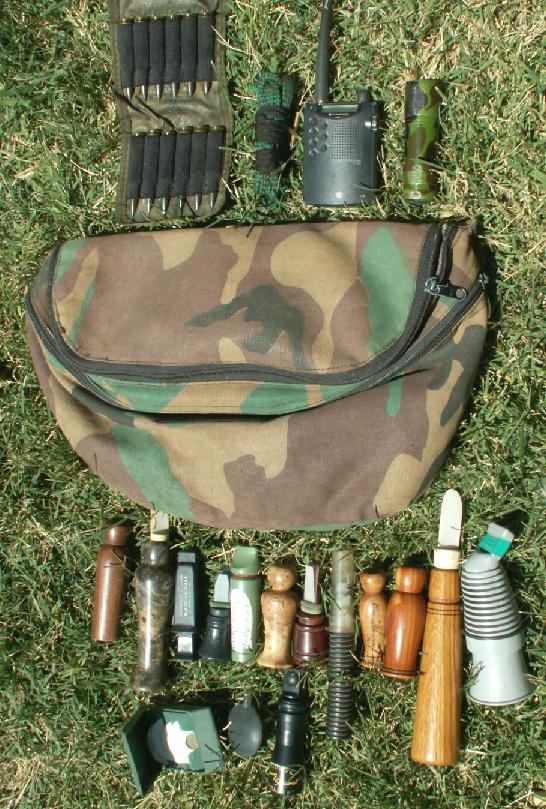 |
The various calls I carry in my fanny pack are:
Top Row:
Bottom Row:
Bottom:
|
RABBIT SCREAMS.... My second favorite is a pair of calls
and they are the Circe Jackrabbit and Circe Cottontail calls. The jackrabbit call is loud! It
can be raspy and have lots of emotion. The cottontail call is not
quite so loud, but I have brought in coyotes from a mile away with
it. Be sure to use your hand around the end of the call, causing
back-pressure and then releasing the pressure. Opening and closing
your hand around the end of the call is almost as important as the
air pressure on the mouth end.
The Johnny Stewart's PC-1 vari-pitched call is very good. It has
a rubber button that you can bite down on and a tiny teat of rubber
that clamps the metal reed. You can make all of the jackrabbit and
cottontail pleading sounds with it. It is very good there, but you
can make it sound like a hurt coyote pup. That is
where it shines. You can duplicate the ki-yi high-pitched sounds of
a pup being trounced by a big invading male coyote. This call is
great in the springtime or early summer when the pups are still
young and haven't left the home range.
COYOTE HOWL.... The Dan Thompson coyote howler call is
the best howler I have used. I can talk a pretty good "hurt
rabbit", but when I talk "coyote", I am not sure I am always using
the correct message. I am improving with howling, and on several
occasions, it has worked very well. A regular greeting howl sometimes works. Repeat it three times, then wait a
few minutes and then repeat the series. They will seldom answer.
When they come in, it will usually be a slow and quiet approach.
They fear you might be a much bigger coyote than they are! They
come in with caution, but not always. I once saw 4 coyotes running
across a flat area about a mile away. I tried the Circe Jackrabbit
call on them and there was absolutely no effect. I gave three
greeting howls and they turned on a dime and started trotting my
way. I made no more calls and they continued toward me. There were
some bushes in front of me (bad situation). Well, they never did
stop. When the scope was full of fur, I missed one and never got
another shot. It happens that way some times! There were four of
them, and maybe that is why they came in so fast.
MAKING THE COYOTE HOWL.... It is difficult to explain in
words how to make a greeting howl, but I will
give it a try. The greeting howl is 2 or 3 barks followed a 2 to 3
second high pitched howl. It takes a lot of practice to get it
right. To make the two or three barks at the start you put about
80% of the Dan Thompson Red Desert mouthpiece in your mouth (with
the reed up) and do a sharp fast "huff" into the call and at the
same time you pull the mouthpiece out of your mouth about a quarter
of an inch. The long howl at the end starts like a bark, but you
pull the mouthpiece out of your mouth about half way and squeeze on
the reed to make the pitch go higher. The challenge bark has the 2 or 3 barks followed by a high
pitched howl for about 1 second. During the short howl, the
pressure is varied to make the variable pitch during the howl. It
will take a lot of practice. VarmintCaller.com Good Calling Sequences and Custom
Calls.
HOW YOUR HOWL SOUNDS TO THE COYOTE.... One thing to remember is that the howl that you are making is going to be heard way out there, maybe 400 yards or more. It does not sound to the coyote like it does to you as you make the howl. It might sound raspy or not perfect to you, but at that distance the coyote merely hears a "howl". All of the detail that you can hear as you are blowing the howl is lost as the sound travels 400 yards or more. The higher frequency sound details are attenuated more traveling through the air than lower frequencies. If the coyote was sitting right next to you he would know that the howl is fake, but at a distance he can't tell the difference. Coyote howling works. Get a howler and give it a try. It is easy to talk the coyote with practice.
COYOTE TALK WITH A HOWLER.... I
took Steve, a young kid (22 years old), out calling with me. We
setup on each side of a pond on the hillsides about 250 yards
apart. I could watch the hillside in back of Steve and he could see
anything coming into the call above and behind me. Well about 3
minutes into the rabbit cries with a Dan Thompson PC-3 here comes a
coyote off to my right at a fast run. At about 30 yards, I tried to
swivel to the right (difficult for a right handed shooter) and the
coyote spotted the movement and reversed directions and went up the
hill behind me and out of sight and also out of sight to Steve.
Thinking there might be another coyote in the area, I continued
with the rabbit screams and the coyote started a warning bark. I
used the Dan Thompson Red Desert Howler and answered with a
challenge bark. The coyote answered back with a challenge bark. I
continued to talk to him for about 15 minutes. I was hoping he
would move to a location where Steve could get a shot. Later Steve
told me he was seeing glimpses of him, but he would only stay still
for a second or two and then move out of sight again. Finally, I
switched back to the rabbit screams and here comes two more coyotes
at a dead run off to the right. Again I had to swivel to the right
and I was just ready to line up on one as he stopped and he
dropped. Steve got him from across the canyon. The other one ran
off and the first coyote quit barking.
It was one exciting stand and Steve came across the canyon telling
me all of the things he had seen. I have a calling partner for
sure. I called in 3 more coyotes at different stands later in the
day and Steve got another one that was just a young pup. It was a
good day and the howler made the difference between success and
failure on that first stand. Don't give up when they start barking
at you. Remember that ALL the coyotes in the area will be listening
and even if you can't get the one who has spotted you and is
barking at you to come in, the others might come in like they are
on a leash. Also it is very good calling practice to learn coyote
talk when you answer each one of his barks and switch it over to a
challenge bark.
MORE COYOTE TALK WITH HOWLERS.... I was up on a
camping/hunting trip in the High Sierras and camped on Baltic
Ridge. The coyotes in the area must have been call wise. I tried a
number of stands with rabbit scream calls. I didn't bring in a
single coyote. I did see some bear tracks and was cautiously
watching my backside during the calling.
The second morning, I got to a good overhanging rock with an
excellent view of any approaching coyote and decided to try calling
with a howler. I have the Dan Thompson Red Desert Howler and a
Songdog Howler. The Dan Thompson is a bit on the high pitch side
(young coyote) and the Songdog howler is even higher pitched (very
young coyote). Here is how it went:
SIMULATING A FIGHT.... I sounded two greeting calls with
the Dan Thompson Red Desert Howler. I heard an answer from a couple
of coyotes more than a mile away. I answered with a couple more
greeting calls. I waited about a minute and then sounded about six
challenge barks with the Dan Thompson Red Desert Howler. Then I
answered these with a series of challenge barks from the Songdog
howler. I waited about 3 minutes and then started a series of three
hurt pup calls with the Songdog howler. That was it. I quit
calling. During all of this calling, there were no answers from the
distant coyotes. About 10 minutes later a large male coyote came
trotting up the hill and made a fatal stop at about 100 yards in
clear view.
During the complete series of calls, no rabbit screams were used at
all. I was trying to create a series of calls that would simulate a
fight between two young coyotes. The idea was that the coyotes in
the area would then want to run both of them out of their
territory. Well, it worked.
DENNIS KIRK HOWLER.... I received my new Dennis Kirk
Howler in the mail yesterday. It sounds pretty good. It is a little
larger in diameter than the Dan Thompson Red Desert Howler, but not
too much. It will still fit in my fanny pack. I have played with it
a little and here is a pretty respectable greeting howl on it. I will try it in the field and report here on
how well it works.
SD COYOTE HOWLER.... I received the SD Coyote Howler by
Steve W. Thompson in the mail. I tried it out here in the computer
room and the dogs went wild. It is very easy to blow and sounds
pretty good to me. It does not sound like a big male coyote, more
like a young male or a female. I will try it in the field in a few
days. Saturday is the first day of pheasant season and I have to do
my duty and walk the dog, but next week I will test it in the
field. Here is a greeting howl with it. One pro caller
said I am holding the howl a bit too long. I will try to shorten
things up a bit in the future. Here is a challenge bark that sounds pretty good. And finally here
is a hurt pup being chewed up by a big alpha male
and calling for his mother, while he is trying to get away. I think
Steve has a pretty good call here. Email Steve if you want to
talk to him about calls.
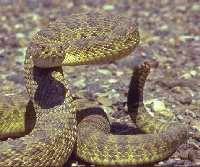
Crotalus viridis viridis
 RATTLESNAKES.... Steve not only makes a good coyote
call. He also has a web site with a wealth of information about
Rattlesnakes plus the
distinctive rattling sound.
RATTLESNAKES.... Steve not only makes a good coyote
call. He also has a web site with a wealth of information about
Rattlesnakes plus the
distinctive rattling sound.
 CHEAP DIAPHRAGM
CALL.... I have been using a new call for coyotes that
is working very well. It takes a while to learn how to use it, but
it is time well spent. It is an H.S. STRUT Mag 3.5 Diaphragm Wild
Turkey Call. The call has 3 reeds closely spaced and one reed
spaced back halfway up the opening. I got it from Wing Supply at
800-388-9464 Model No. 9900832 for $1.99. That price is hard
to beat. The call is placed on the roof of your mouth with the open
end of the "U" pointing out and the short reed facing down toward
your tongue. I am not good at making turkey sounds, but here is the
call imitating a hen turkey. By using more pressure
and longer sounds, the same call will make good raspy sounding
hurt jackrabbit screams. Turn the call over and it
behaves like a single reed call without the raspy sound. Here is a
fairly good fawn bleat. Add some pressure with sharp
bursts and you have a coyote hurt pup call.
That is quite a variety of sounds for one call. Using the call,
your hands are free and you can be looking through the scope and
still calling. When they stop at 200 yards and you want to coach
them a bit closer, try blowing softly and make rabbit whimper sounds. This sounds like the rabbit is just
about dead and brings them right in. This is really a very soft
sound, but it sounds loud on the computer system.
CHEAP DIAPHRAGM
CALL.... I have been using a new call for coyotes that
is working very well. It takes a while to learn how to use it, but
it is time well spent. It is an H.S. STRUT Mag 3.5 Diaphragm Wild
Turkey Call. The call has 3 reeds closely spaced and one reed
spaced back halfway up the opening. I got it from Wing Supply at
800-388-9464 Model No. 9900832 for $1.99. That price is hard
to beat. The call is placed on the roof of your mouth with the open
end of the "U" pointing out and the short reed facing down toward
your tongue. I am not good at making turkey sounds, but here is the
call imitating a hen turkey. By using more pressure
and longer sounds, the same call will make good raspy sounding
hurt jackrabbit screams. Turn the call over and it
behaves like a single reed call without the raspy sound. Here is a
fairly good fawn bleat. Add some pressure with sharp
bursts and you have a coyote hurt pup call.
That is quite a variety of sounds for one call. Using the call,
your hands are free and you can be looking through the scope and
still calling. When they stop at 200 yards and you want to coach
them a bit closer, try blowing softly and make rabbit whimper sounds. This sounds like the rabbit is just
about dead and brings them right in. This is really a very soft
sound, but it sounds loud on the computer system.
OTHER COYOTE SOUNDS.... Here is the challenge bark. Repeat this in a series of threes or
fours, for about a minute. I believe this tells any coyote around
(in the California dialect) that you're new in the territory and
you're going to take over. This is an invitation to fight. You
won't bring in many females or young males with this call.
Finally, the mouth diaphragm calls are very good. They take the
most work of all. You really have to use air pressure and lots of
diaphragm control to make them sound correctly. I used to play a
bassoon in the 8th Army Band in Seoul, Korea and it is as hard as
playing the bassoon to get the most out of them. Again, the
standard predator diaphragms will make the jackrabbit and
cottontail sounds. If you get a standard hen turkey call, you can
make a great hurt coyote pup call. The hurt pup call
works, even in areas where lots of calling has been done and there
are no virgin ears around.
CALLING WITH
EMOTION.... I like to start the calling with a medium volume.
While calling, picture in your mind's eye a cottontail just being
caught by a bobcat. The cat takes a bite on its shoulders. The
cottontail is surprised and suddenly starts urgent screams. After a
few screams, the cat relaxes a bit and the urgency decreases to a
whimper. The whimpers have a quivering, crying, pleading sound.
Then another bite and it hurts. Urgency again and the rabbit is
getting weaker. Then the cat starts biting off chunks and the
urgency is there, but the strength is going and more quivering. If
the coyote out there doesn't get here pretty fast, there will be
nothing left to eat! Now the screams are slower and weaker, almost
like moaning. Visualize your calling this way. It makes for much
more believable sounds. The same thing applies if you are doing the
hurt coyote pup call. Watch that big male coyote take a bite and
the pup cowers and screams and whimpers.
NEW CALLING
SEQUENCE.... I have recently been using a new calling sequence
that has brought in 4 coyotes in the last two outings. Here is how
it works. I start with the medium sized Dan Thompson PC-2 rabbit
call and blow a series of rabbit screams for about 2-3
minutes. I wait for about 3-4 minutes and then blow two greeting howls with the Dan Thompson Red Desert Howler. I
try to make the howls on the anemic side representing a young
coyote. I didn't get an answer and don't expect an answer to the
howl. You are in the coyote's home territory and he will come to
run you off for eating one of his its rabbits. The anemic howl has
told him that you are weak and a pushover. At least, that is the
theory.
CALLING
DURATION.... My calling sequences take about 2-3 minutes until
the rabbit is just about dead. Then I wait about 3-5 minutes and
repeat. If it is a really good location, I will revive the rabbit
for another 2-3 minute sequence. Then I sit there for at least
another 15 minutes. I have had some "walk-in" coyotes. They know
where the sound was coming from, but they were in no hurry. When
you finally feel nothing is coming and are ready to quit, stand up
at the alert. A coyote could be sitting where you can't see him and
then he will show himself. Do a complete 360� scan before you
leave.
OLD DOG LEARNING NEW TRICKS.... I
was on a recent hunting/fishing trip into the Sweetwater Mountains
of California and I successfully called in a couple of coyotes. The
new trick I learned is how to make the rabbit squeal sound raspy
without humming into the call. I was using the Dan Thompson PC-3
call that produces rabbit screams and it is very good. I had been
using it by blowing into it and using my hand opening and closing
the end of the call to make the sounds. PC-3 plain is how it sounds when I blow it this way. This
is a very productive sound and does bring in coyotes. But, I have
heard that humming into the call works better. I don't think so.
PC-3 hum is how it sounds when I hum into the call
as I am blowing. This does not sound right to me.
MAKING THE RASPY
SOUND.... Here is the new trick. I played an Alto Horn and
Trumpet when I was in the Marching Band in Korea. (I played a
bassoon in the concert band). I was sitting there calling coyotes
and nothing was coming in and I got to looking at the mouthpiece of
the call and it looks like a trumpet mouthpiece! I am sure that Dan
Thompson made it that way on purpose. So, I thought I would try the
call while blowing it like a trumpet. WOW! What a sound it makes
when you blow the call that way. It has a raspy ness that just
reeks of a coyote chewing apart a rabbit while the rabbit is
choking on its own blood. PC-3 Raspy is how it sounds
when you use the call like a trumpet mouthpiece. I make a light
raspberry sound with my lips like blowing a trumpet as I am
calling. If you have a call with a mouthpiece like this, give it a
try. It takes a little practice, but is very easy to do.
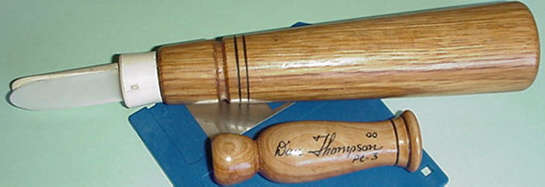
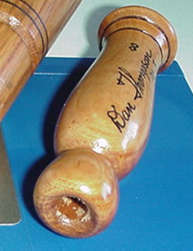 |
Dan Thompson Game Calls Red Desert Howler & PC-3 Coyote Calls You may reach Dan at:
|
A CALLING SEQUENCE THAT WORKS.... Here is the calling
sequence I was using that was working very well. I would start with
two or three coyote howls using the Dan Thompson Red Desert Howler.
In the photo above, the calls are sitting on top of a floppy disk
so you can get an idea of their size. DT Howl 1 and DT Howl 2 are what the howler
sounds like. Note that the pitch is high and squeaky. I am not
trying to imitate an alpha male coyote that has a low pitched howl.
I am trying to imitate a young coyote who doesn't know what he is
doing. This weak and immature call invites the local coyote pack to
come and run the intruder out of their territory. After the howls,
I wait about two-three minutes. If any coyotes are close, they
might come in quietly. I have not had any coyotes answer the howls.
(Twice, after writing this, I have had answers, but it is very
unusual.) Then I start with the PC-3 Raspy 1
using a low volume. I make that call for 20 or 30 seconds and then
quit. In another two or three minutes, I switch to a louder
PC-3 Raspy for another 30 seconds or so. After about
10 minutes or 3 series of this and if nothing shows, I do the
PC-3 Flutter in case a coyote is hanging up out of
sight. If you have a call with a mouthpiece shaped like a trumpet
mouthpiece, give this technique a try. If I have only a few places
where I can make stands, I repeat the whole series again from start
to finish. I usually just sit quietly after I finish calling for
about 10 or 15 minutes. I have had "walk in" coyotes that leisurely
come in to investigate. Note: In the new Lock, Stock &
Barrel Catalog, I notice the they carry the Dan Thompson line
of calls.
Coyote anemic greeting howl #1 Dan Thompson Red
Desert Howler
Coyote anemic greeting howl #2 Dan Thompson Red
Desert Howler
Rabbit scream Dan Thompson PC-3 plain
Rabbit scream Dan Thompson PC-3 humming
Rabbit
scream Dan Thompson PC-3 raspy playing trumpet
Rabbit scream Dan Thompson PC-3 raspy flutter
ELECTRONIC CALLS.... I have tried an electronic call. It is a "Trucall 1.1" and looks like a bullhorn. It has 10 electronic sounds. I got it about 3 years ago from Wing Supply, but they don't list it anymore. Note that the numbering on the list was probably done by the programmer who wrote the software for the chips. To a programmer, a zero is a perfectly good number in a list! ;-)
0. Bark Howl Coyote (really a greeting howl)
1. Course Cottontail
2. Distress Jackrabbit
3. Distress Fawn
4. Squeaker Rodent
5. Grey Fox Pup (I like this one the best)
6. Distress Woodpecker
7. Raccoon Squaller
8. Fighting Crow-Owl
9. Multiple Baby Crow
I have used it about 30+ times, in some really good locations and have called in only 2 coyotes. My success rate is much better with hand calls. The sound quality has a lot of "white noise" along with the sounds. It is loud when you turn up the volume! It runs on 8 AA batteries and only weighs about 3 lb. The sounds are generated on a chip and are repeated about every 30 seconds. Same series over and over. It is still in my truck, but it is gathering dust. I like the hand calls and diaphragm calls a lot better and they are more effective for me.
I have another old electronic call that is merely a tape player with a gel cell battery in a tool box. I have tried it about 20+ times and have NEVER brought in a coyote with it. I gave up on it altogether. The sound quality was not good.
FAWN CAUGHT IN A
FENCE.... If you are in deer country where there are barbed
wire fences, here is a trick you can try. One time or another,
every coyote out there has probably caught a meal that has been
entangled in a fence. Make your stand next to the fence midway
between the posts where you can see well and try this. Make the
fawn in distress call like this (see the section on deer
calls). While you make the call, take a stick or your hand and hit
the wire of the fence simulating a fawn struggling on the fence
wire. The wire sound will travel a long way down the fence
line.
 FAWN
BLEAT.... A few weeks ago, there was a TV news story about a
fawn trapped in a sewer drain. The police roped the fawn and pulled
it out of the hole. While the guy was holding the fawn, it was
bleating. I got out a call and tried to imitate the sound. Here is
the Fawn Bleat with an old single reed diaphragm
call. It works too. Yesterday, I went to one of my coyote hunting
places and tried it out. These coyotes are smart and they have
heard everything I have to offer. I setup where I had a good view
of the hillside around a small pond. I started with the fawn bleat
using a tube call. After 5 minutes, nothing. Then I switched to a
diaphragm call (it sounds better with the diaphragm call) and after
5 minutes more, there was a new object up on the hillside. It was a
big male coyote sitting looking at me at 300 yards. With the 243
Sako, I dialed in 275 yards on the scope and setup on my Bi-Fur-Pod
and touched one off. Bang -- Whoop! He tumbled over like a sack of
flour.
FAWN
BLEAT.... A few weeks ago, there was a TV news story about a
fawn trapped in a sewer drain. The police roped the fawn and pulled
it out of the hole. While the guy was holding the fawn, it was
bleating. I got out a call and tried to imitate the sound. Here is
the Fawn Bleat with an old single reed diaphragm
call. It works too. Yesterday, I went to one of my coyote hunting
places and tried it out. These coyotes are smart and they have
heard everything I have to offer. I setup where I had a good view
of the hillside around a small pond. I started with the fawn bleat
using a tube call. After 5 minutes, nothing. Then I switched to a
diaphragm call (it sounds better with the diaphragm call) and after
5 minutes more, there was a new object up on the hillside. It was a
big male coyote sitting looking at me at 300 yards. With the 243
Sako, I dialed in 275 yards on the scope and setup on my Bi-Fur-Pod
and touched one off. Bang -- Whoop! He tumbled over like a sack of
flour.
When I climbed up to him, I could see his track in the grass and he had headed from up-wind to get down-wind of my position. I noticed a lot of coyote scat in the area and it was solid black/dark brown hair from cows and calves. The farmer will be happy to find out about one less coyote. Give the fawn bleat a try. Sound out about 6 or 7 bleats then wait a minute or so and then repeat.
More on the fawn bleat two days later. I went to a different
section and tried the fawn bleat call again. I gave out a series of
6 calls and quit and waited. About 30 seconds later here comes a
critter from up wind about 350 yards out at a hard run straight
toward me. It was a doe! She continued the hard run until she was
about 100 yards out and stopped. Well, I was still trying to bring
in a coyote, so I ignored her and gave out another series of fawn
bleats. The doe charged toward me and stopped about 40 ft from me.
I was getting a bit nervous that I should stand up and let her know
what I was. She started making the doe warning cough
at me and began to move around me to a down wind position. After a
standoff of about five minutes, she had moved enough to get a whiff
of me and she took off and stopped about 200 yards out. Well, I
continued to call and now had a live decoy out there coughing at me
at regular intervals. It was interesting, but all I called in was
the doe. I must have the sound of the fawn bleat down pretty
well!
WATCH
THE TRAILS.... Where is the coyote going to come from? Coyotes
like a quiet approach. Using the trails is easiest and makes the
least noise. Busting through the brush or tall grass makes the most
noise. Look for them to come in on a trail or an old road. They
will most often use the line of least resistance. I hunted near a
large lake a couple of years ago. Up each drainage into the lake, I
would check the dry wash for a trail. If there was a
well-established trail with coyote tracks, it was easy. I would
make a stand where I could see about 100 to 200 yards of the trail.
Start calling up the canyon and watch the trail. Got two coyotes at
that lake coming down the trails. I called in a third one to within
20 feet of me on the inlet streambed and never got a chance for a
shot. I didn't follow my own 100-200 yard recommendation!
INDICATORS.... Watch and listen for indicators
that a coyote is approaching. Out here in the west, one of the best
indicators is the ground squirrel.
 When they first
see a coyote, they will give a warning burst of chirps and then
continue with single chirps about every 2 seconds. If you can see
the squirrel that is chirping, the way he is standing will be an
indication of the direction of the coyote. The squirrel will be
positioned so either the right or left profile will be facing the
coyote. Remember, "eyes to the sides" is prey and "eyes facing
forward" is predator. Squirrels eyes are designed for 360�
viewing.
When they first
see a coyote, they will give a warning burst of chirps and then
continue with single chirps about every 2 seconds. If you can see
the squirrel that is chirping, the way he is standing will be an
indication of the direction of the coyote. The squirrel will be
positioned so either the right or left profile will be facing the
coyote. Remember, "eyes to the sides" is prey and "eyes facing
forward" is predator. Squirrels eyes are designed for 360�
viewing.
DEER AS AN INDICATOR.... Another good indicator is deer. I was once calling when a spike buck stepped out in the open about 250 yards up wind. He watched me call for about 5 minutes, then turned his head to the side for a few seconds and then quickly bolted out of sight. From behind the direction he ran, two coyotes appeared. I got one, and almost got the second. Just wasn't fast enough with the bolt. Cattle also make good indicators. While you are calling, they should be looking at you. If they start looking in a different direction, there is probably a coyote coming in from that direction. I was calling from under an oak tree and there were about a dozen cows watching me on the far hillside at 200 yards. All of a sudden, the cows spooked and sure enough there was a coyote on the hillside in the thick trees. I played peek a boo with that coyote for about 15 minutes. The cows had stopped and were looking in his direction. I could tell about where he was, but he wouldn't show himself, and wouldn't leave. I was using the hurt pup call and giving the ki-yi's at about 2 minute intervals. I could catch glimpses of him between the trees. Finally he stopped for about 3 seconds in a 2 foot clearing. That's all it took. It was a big male.
Listen for birds too. Birds in the tree tops will often harass a moving coyote. If you see a bunch of birds fly off all of a sudden, that is an indicator. Often crows will circle you while you are calling. Watch to see if they circle another area. There could be a coyote there.
 GETTING
CLOSER.... You are calling and you see a coyote coming in, what
do you do? This is a tough one. If I am actually blowing on the
call and I see a coyote on a fast approach, I have a tendency to
stop calling in mid scream and drop the call in the dirt and move
the rifle toward him. Most of those times that reaction didn't work
very well. The coyote saw me, too! On my cooler moments, I whimper
off the calling (rather quickly), then sit still while the coyote
is still coming in. Remember that, while he is getting closer, your
chances are getting better. Also, it takes about a minute to really
get fully pumped up with adrenaline and to make it practically
impossible to hold the rifle steady! ;-) Try to wait until the
approaching coyote goes behind something or is watching where he is
running. Then, get your rifle lined up. Taking a standing shot at
250 yards is much easier for me than a 50 yard running shot at 45�
quartering away. Try to wait for a standing shot. When they stop
closer than about 75 yards out and look at you, you will usually
have about 1-2 seconds to do the deed. Practice the fast trigger
squeeze on some of the closer ground hogs or ground squirrels.
GETTING
CLOSER.... You are calling and you see a coyote coming in, what
do you do? This is a tough one. If I am actually blowing on the
call and I see a coyote on a fast approach, I have a tendency to
stop calling in mid scream and drop the call in the dirt and move
the rifle toward him. Most of those times that reaction didn't work
very well. The coyote saw me, too! On my cooler moments, I whimper
off the calling (rather quickly), then sit still while the coyote
is still coming in. Remember that, while he is getting closer, your
chances are getting better. Also, it takes about a minute to really
get fully pumped up with adrenaline and to make it practically
impossible to hold the rifle steady! ;-) Try to wait until the
approaching coyote goes behind something or is watching where he is
running. Then, get your rifle lined up. Taking a standing shot at
250 yards is much easier for me than a 50 yard running shot at 45�
quartering away. Try to wait for a standing shot. When they stop
closer than about 75 yards out and look at you, you will usually
have about 1-2 seconds to do the deed. Practice the fast trigger
squeeze on some of the closer ground hogs or ground squirrels.
THE STAND.... Walk into the wind to set up your stand if possible. Sit in front of some object to break up your outline and sit in the shade if possible. I have had coyotes come very close, even when I am out in the open with no camo or backdrop. Coyotes see things, but they are not sure what they are looking at. But when coyotes smell you, they know instantly and exactly that you are danger and vacate fast! Pick a location where you can see out 100 yards or more in front of you and to the sides, if possible. If you call where there is no clear view of the coyote's approach, they will come in behind cover and you won't see a thing. You will only have made another wise coyote! That coyote will probably never come to your call again. Next time, his refusal to come to the call will also alert any other coyote with him to avoid your call. If there is some cover or bush right in front of you, any coyote that comes in will use that cover and stay behind it where it can't be seen. Sit in front of the bush to avoid this, if possible.
HAVE THE RIFLE READY.... I have the rifle ready for action before I start calling. I setup my Bi-Fur-Pod sticks and put the rifle on them with the buttstock to my shoulder in the shooting position. I check to make sure the scope is on low power (4X on the Tasco) and set the objective to 200 yards. The parallax will not be a problem for close shots and I won't have to make an adjustment for a longer shot. If a coyote hangs up at 250-300 yards I will have time to increase the scope power, but when a coyote appears close, I will not be able to move or have time to adjust the scope. It gets exciting looking at a coyote at 10-20 yards!
HUNTING PARTNER.... Place your hunting partner to the left or right, where he can see behind you (down wind). If you are near the bottom of a canyon, you can call from up one side and your partner can sit on the other side where he can see above you. The idea is to pick a place where your partner can watch the coyotes approach you, even if you can't see them. I have done most of my hunting solo. You can do a very good job by yourself, but there will be some coyotes that will circle and sneak up on you from downwind and then leave and you won't have any idea that they are there.
HUNTING WEATHER & TIME OF DAY.... This is easy. Go hunting every chance you get. You will have a difficult time calling when the wind is much stronger than 10 MPH. You can't be heard very far up wind, and downwind has your scent splattered all over the place. I haven't tried much calling in the rain. I will leave that for the more hardy and dedicated hunters to discuss. The best time of day to hunt is early morning before sunup. Get to your stand and wait until you can clearly see any approaching coyotes. Start calling softly. The coyotes will be active and on the move between first light and sunup. You can hunt all day long. I have called in many coyotes right in the middle of the day. Around sunset, the coyotes will be on the move again and it is also a very good time to call, but when it gets so dark you can't see an approaching coyote, you might call one in and spook it so it will be wise to the call.
NO NIGHT HUNTING FOR ME.... I don't hunt at night and have no experience with hunting at night with lights. I hunt on mostly private land with cattle and other livestock. I often make a stand very near the cattle. The ranchers don't want to hear shots on their land at night and I can't blame them. I want to be very sure it is a coyote before I shoot and I can't do that in the dark. I also need to be sure of what is behind the coyote before I take the shot.
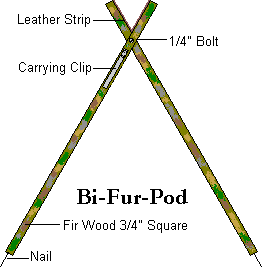
There is now a separate page for making a
Bi-Fur-Pod Rifle Support.
Click to go to the Bi-Fur-Pod Rifle Support
Page.

I recently received a Wiley One Howler. It makes a
very good coyote howl and an excellent hurt pup sound. Here are
some example of the sounds.
Coyote Howl with the Wiley One Howler
976KB
Hurt Coyote Pup with the Wiley One
Howler 963KB
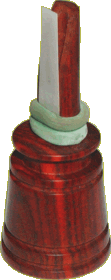
Long
Valley Predator Call
by
Brett Wilson
PO Box 304
Antlers, OK 74523
(580) 298-9083

LONG VALLEY PREDATOR CALL.... I have been using the Long Valley Predator Call lately. Is is in open reed call. The mouthpiece is not inserted, but machined as and integral part of the call body. The call is very easy to blow and control. It makes a very good young coyote howl and a wicked hurt jackrabbit scream. On the very first outing I called in a young coyote. I had Tide with me, on his second coyote hunt, and Tide bolted at the sight of the coyote, about 30 yards. The coyote took off over a rise and was into full afterburner by the time I saw him again and I performed a perfect miss! Brett does not have a web page for his calls. If you are interested in a well made custom call, give Brett a ring.
MARSH CREEK.... Tried coyote calling on
Marsh Creek today (5/24/05). I started with the Johnny Stewart PC-1
at the first 3 stands and no takers. I got to the place where I
made the very first stand with the rancher 15 years ago, and he
missed a coyote. At a later stand back then we got a big male that
came into a diaphragm call. The rancher was impressed and gave the
keys to all of his gates.
FAST MOVING CATTLE.... I moved a little farther to the east
that old stand and started with the Long Valley Predator call. It
is very easy to blow and I was doing a Jackrabbit scream. The first
thing that happened was that about 50 cows that I hadn�t seen
started running toward me. They came in to about 40 yards and
stopped. I stayed seated and gave another series of Jackrabbit. The
cows took off running away as fast as they could go.
CHANGE SOUNDS - SAME CALL.... Not to be discouraged, I
started pinching up on the open reed and made higher pitched rabbit
sounds. Here comes the cows again. They hold up at about 30 yards
and they look like they are going to be mean. I am thinking about
standing up and waving and hollering at them. The cows look start
looking nervous and one calf starts bellowing. I give out some more
Jackrabbit and the cows turn and run off again. I relax and start
the high pitch sounds again. Off to the right here comes a scraggly
looking coyote. All I could do is move my sticks to the right. The
coyote runs off down the hill out of sight.
GETTING READY.... The coyote can't leave completely without
me seeing it at about 150 yards. So, I swivel around and get setup
in the direction the coyote took. At about 140 yards, it comes into
sight. It wasn�t running very fast, but I am not good at running
shots. I held up and whistled at it like one would a dog. It
stopped. That was all it took. One second later, the .243 95 gr
Nosler Ballistic Tip caught it right behind the shoulder. She went
about 30 yards and piled up in the long grass.
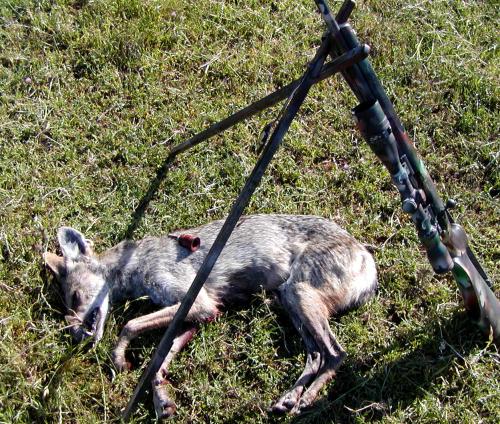
POOR CONDITION AND MANGE.... Here is a picture of the dry
female. She had mange and her pelt was very poor. Even with a poor
pelt, she could still do damage to the cows while they were
calving. The rancher will be happy when I write him a letter
telling him about the hunt.
Second coyote at the old Red Barn.
TOO DRY FOR GROUND SQUIRRELS.... I was going
to do some ground squirrel control. I have access to an old dairy
ranch and long ago there used to be a big red barn. Well, the red
color faded years ago and last year if one looked carefully, he
could see a hint of red. This year, the barn collapsed into an
antique wood pile. Most of the ground squirrels are in the next
field to the west where I was working on them last year.
WHEAT READY TO HARVEST.... Went to this location to shoot
some ground squirrels, but the rancher is growing wheat there and
it is popcorn f@rt dry and I didn�t want to do a lot of shooting in
those conditions. I didn't want to take a chance of causing a fire.
Since I was already there, I very carefully parked my truck so the
catalytic converter would be in the clear and not touch any dry
grass where it could possibly start a fire.
MADE A STAND.... I walked in the last � of a mile and made a stand. I used the Long Valley Predator Call and started with some very high pitched screeches. A couple series of these and no coyotes, but the ground squirrels came alive and were chirping at me. I switched over to a very loud cottontail scream and still nothing. I could see 3 or 4 ground squirrels setting up and one was giving me the steady chirp -- chirp -- chirp. I was about to give it up and decided to give out a hurt pup. There was nothing to foul up since the stand couldn�t get any worse than nothing. On the second series of hurt pup calls, I spotted a coyote heading my way at about 300 yards. He was difficult to see because the grass and wheat was very tall. At about 175 yards the coyote got to the spot of the red dot in the picture and stopped. The Sako barked and I heard the WHOP! The coyote went down. I continued with the hurt pup call for another 10 minutes, but nothing.
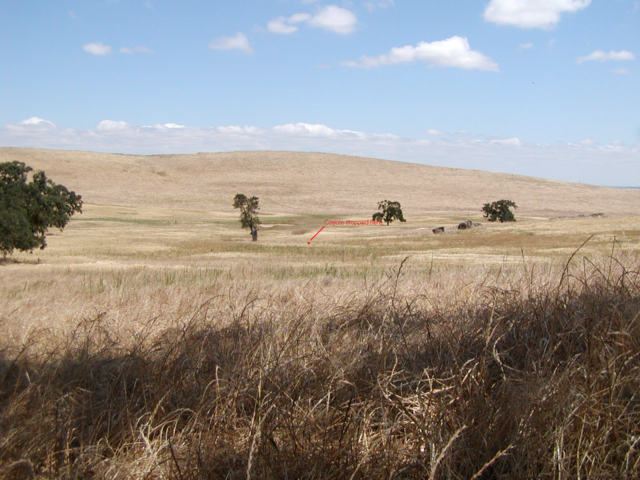
The coyote stopped at about 175 yards, see the red dot in the
picture.
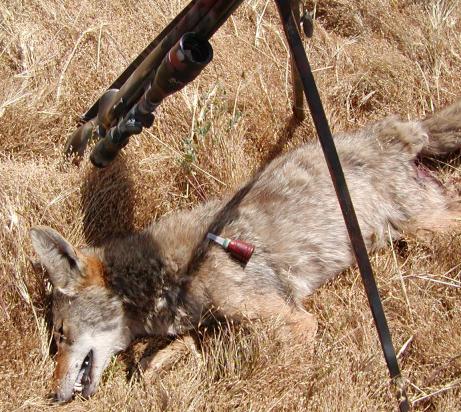
Used the Long Valley Predator Call to bring in this coyote.
YOUNG MALE COYOTE.... When I got to the coyote, he could raise his head so I applied the finishing shot. It was a large male and from his teeth and very little wear, he appeared to be about 2 years old. I will have to wait until they harvest the wheat before I can work on the ground squirrels in that area. There appear to be quite a few of them and with all that wheat they should be fat targets in a couple of months. I left that property and went to the next area I have access to, but the rancher was rounding up his cattle so I left that area. I didn�t want to bother him. One aside. The last time I talked to this particular rancher he wanted one of my �Business Cards� so he could prove to his rancher friend up in Canby, CA that he really knew Varmint Al. The web page does pay off.
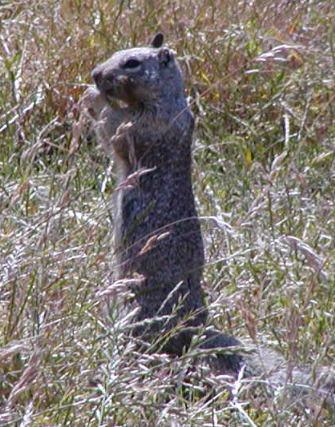
A photogenic ground squirrel at the upper pond.
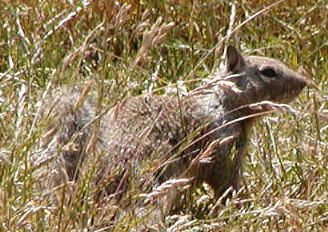
Another view of the same ground squirrel. He got a pass.
GROUND SQUIRREL CONTROL.... Went to the third piece of property and after going through one locked gates 4 other gates I made 2 coyote calling stands, but no takers. However, the upper pond had a number of young ground squirrels on the dam face. I got out the CZ 452 17 HMR and did a little ground squirrel control. The only shade I could sit in was only about 75 yards from the dam and I went 30 straight on ground squirrels. That CZ sure is a great shooting rifle. I have about 300 rounds through the barrel since last cleaning and see no need to clean it now. It sure seems to like a fouled barrel for best accuracy.
The people at L&M Predator Calls sent me a call to test. It has a medium pitch like a cottontail and has a concave mouthpiece like a trumpet. It really sounds good and with the concave mouthpiece I can make it as raspy as I want. I went up to the Sweetwater Mtns and gave it a field-test. Here is the first coyote.
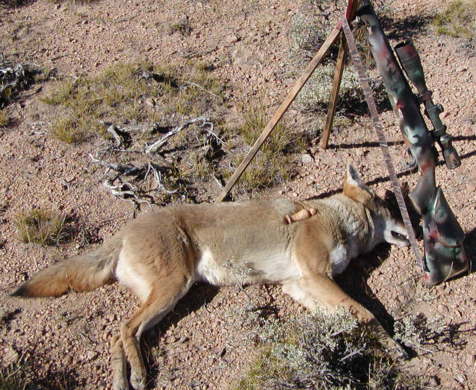
It was about 9:00am and Rush was on the AM radio. I heard coyotes howling on the hill north of Lobdell lake. Well, enough of Rush. I got my rifle and Bi-Fur-Pod and selected the Dan Thompson Howler and the new L&M call. Off we went heading for a good stand in the sage brush. We (Bart hunts coyotes with me) setup in the shade of a small white bark pine tree. I put Bart on a very short leash tied to my belt. If he were to lunge forward, he couldn't get as far as the muzzle of the rifle. I scanned the ridge top with my binoculars and there were 2 coyotes at about 1000 yards and in among the cattle. I gave two greeting howls and they stopped and looked my way. They were not that interested. I started with the L&M call and made a medium volume distress call. The highest coyote started walking toward me and stopped after traveling about 50 yards. The second coyote stopped but didn't come my way. About this time Bart stiffens up and does a very low growl. A third coyote was headed toward us out of the creek bottom. If Bart hadn't warned me, I wouldn't have seen it. This male was circling around and headed downwind and went out of sight over the rise. I moved the sticks around to match his possible approach. I guessed pretty well and he stopped at about 75 yards just peaking at me through a sage brush. That was all the target I needed. One shot and one coyote down.
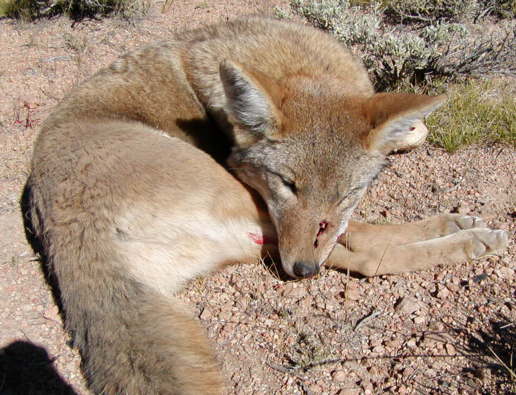
The 243 95 gr Nosler Ballistic Tip entered just above his nose and
there was no exit.
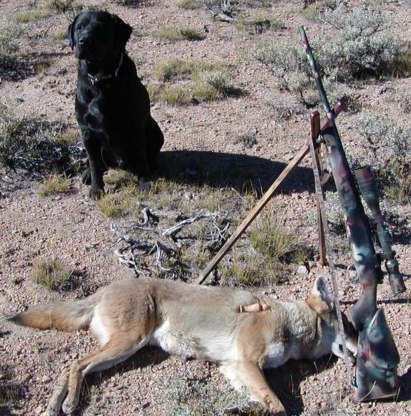
Here is Bart posing with the coyote. He makes a great coyote
hunting dog.
Bart is my eyes, ears, and nose. He watches while I am calling and
is very alert.
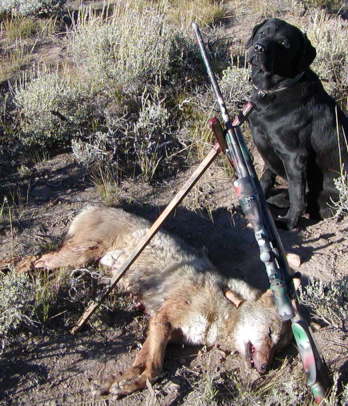
The next morning we got coyote number 2 with the L&M call. This
was near the top of Monitor Pass. It was just after sunrise and we
setup in the shadow of a large outcropping. I picked a pretty good
spot with elevation for visibility. I started calling with the
L&M call and did about 3 series and was just setting and
waiting. About 15 minutes had passed and I was about ready to give
up. Bart started his low growl and there was a coyote coming up the
dirt trail we had walked on to get to the spot. I moved the sticks
around and didn't want to take the shot while the coyote was
walking. I gave a sharp mouth bark and the coyote stopped broadside
at about 150 yards and looked our way. That was all I needed. The
bullet caught him just behind the shoulder and blew out the back
side. Bart did it again. I wouldn't have seen the coyote till too
late if Bart hadn't warned me. Here is more info on two new L&M
Calls.
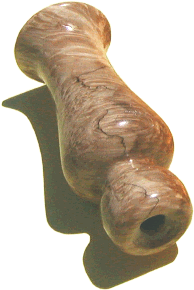 Beautiful L&M Predator Call No. 2 Really works! |
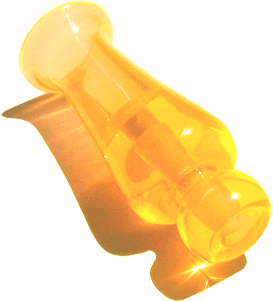 An Acrylic L&M Predator Call No. 3 It sounds great and you won't lose on the ground. |
I received two more predator calls from L&M and have been trying them out. The grain on Call No. 2 made of exotic wood is beautiful. The call has a very good sound. I have called in 4 coyotes in the last two weeks with this call. I have only used Call No. 3 a couple of times so far. It sounds good but no results yet.
SUCCESS WITH THE NEW L&M CALL.... Got the urge
to go coyote calling. It was the last chance I would have to get a
coyote while I am in my sixties. The big "70" occurs tomorrow. I
loaded Bart in the truck and headed to the Marsh Creek area on the
south side of the road. It is summer, but there was quite a bit of
overcast. Went up Sycamore Creek to the pond and made a stand above
the pond. I let Bart out of the truck and he ran off a little buck
with forks in the velvet. Bart likes to protect me. Bart seems to
consider every animal he sees a Grizzly Bear and only relaxes when
he has determined that there is no threat.
We setup under a big oak tree above the pond. I used the E.L.K. Power Howler and at first couldn't make it work. The reed I had made out of the little finger of a N-DEX Tektured Nitrile Glove had stretched and wouldn't work. I had cut a number of extra reeds and put a new one on. I was finally able to get the howler to work. I started with a series of young coyote greeting howl with miscellaneous group calls mixed in. Nothing! I got out the brand new L&M Predator call and did some jackrabbit distress calls. The new call really sounds good. Waited and still nothing. Bart was getting bored and finally laid down. That is not a good sign. Bart can smell a coyote from half a mile up wind. I fussed with the coyote howler for quite a while and finally gave up on it. On the way out, I picked up a good stick and had Bart do a couple of fetches from the pond. There are large black bass in the pond.
BART SAW IT FIRST.... For the next stand we moved to the neighboring property of two sections (have hunting permission there too) and setup about 300 yards upstream from the south pond in the creek bottom. The creek had already dried up, but the pond was still full. We were in the shade of a big oak tree and Bart was on the very short leash at my left side. I started with the Power Howler and it was now working very well. I did a little coyote chatter and then a number of challenge barks and waited about 5 minutes. Nothing. I got out the L&M Predator call and did the hurt jackrabbit series with emotion. I put the call down and started scanning for an incoming coyote. After about 2 or 3 minutes, Bart stiffens up and sits at full alert. I looked where he was looking and a coyote had just topped a rise at about 175 yards. The coyote was standing looking at us.
I was able to slowly move the rifle and Bi-Fur-Pod to the left about 30 degrees to line up on the coyote. I left the scope on 4X and the coyote sure looked small in the crosshairs. Centered it on the chest and touched it off. The coyote went down and rolled down the hill out of sight. I released Bart and we headed over to the coyote. It had rolled about 50 ft downhill in the tall grass and Bart found her. She was a young female and had a broken back and I called Bart off. Once I delivered the finishing shot Bart completely ignored the coyote and was sniffing around the area. There might have been a second coyote, but I didn't see one. That was a pretty good way to finish my sixties and get ready for a next decade.
PRIME GROUND SQUIRREL AREA PLOWED.... On the way home we went by the prime ground squirrel section by the old dairy barn. They had plowed the fields, but left quite a few areas untouched under the oak trees and on the steeper slopes. The grass was about 1-1/2 ground squirrels tall and I caught a glimpse of a few ground squirrels, adults and juveniles, running through the tall grass. There will some good ground squirrel shooting in the fall when the rains start. I forgot to take the camera, so no pictures. I will take some pictures of the two new L&M Predator calls. They sure are nice calls.
ANOTHER HAPPY RANCHER.... Recently, I got access to
a new area to help out a rancher who had lost two calves to
coyotes. I went out Wed morning at first light and walked to the
north edge of the 200 acre field and made a stand. The field is
waist high grass and weeds and is a difficult place to spot any
incoming coyotes. I started calling with the new E.L.K Howler and
the reed was all stuck to the mouthpiece and I couldn�t get a good
sound out of it. Enough for the E.L.K. Howler. So I tried the new
L&M Predator Calls No. 2 that they sent me to try out. Called
for about 3 min. Quit that and just sat and watched for about 10
minutes. Finally I got out my old reliable Dan Thompson Howler and
did a couple of greeting howls. Set there another 5 minutes and
gave out a couple more howls. I still didn't see anything. The
coyote had moved downwind and had busted me. She started a warning
bark at me from about 100 yards in the tall weeds and I couldn't
see a thing.. Well all is not lost when that happens. I started
talking to her with a challenge bark. She answered. We started a
conservation and I kept her answering. After about 10 minutes, the
coyote made a mistake and showed herself at about 175 yards. That
is all it took. The rancher should be happy, but there are at least
three more coyotes in the area that will need attention.


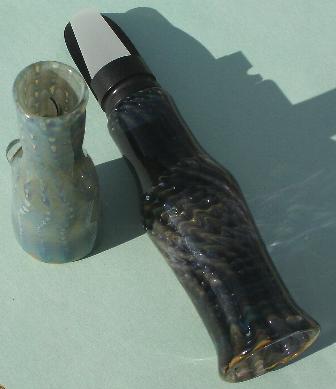
Chris Butcher's Excruciator call and Howler. I like the large bore
diameter of both calls. The open mouth piece on the Excruciator
allows one to blow it like a trumpet and like sipping from a wine
glass. These techniques make for some very excruciating sounds. The
calls are made of borosilicate glass and have a very good sound. I
have created a 16 minute sequence of the Excruciator call. It
starts with 1 minute of silence. Here is a link to the sound
file:
Excruciator
(excruciator-16-min.mp3) A 16 minute sequence of Chris
Butcher's Excruciator call. Starts with 1 minute of silence.
14.89Mb
Chris Butcher's Web Site
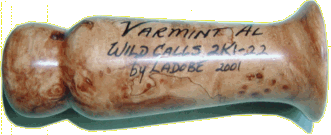
CUSTOM CALL
WildCalls by Ladobe, 2K1-22 predator call.
Click here to view the
back side of the call.
WildCalls by Ladobe, 2K1-22 CUSTOM CALL.... Just got back
from a very short coyote calling session. I went to the next Island
south of Bethel Island and was going to work on the ground
squirrels. It was about 2:00pm and about 90F. This is not the best
time for calling coyotes. Before I did any shooting, I thought I
would give the 2K1-22 predator call a check out. I climbed up on a
shelf of the haystack and setup. I had changed the reed in the call
so it is high pitched because there are very few jackrabbits around
here.
I started out with a series if high pitched cries without any raspy
ness. Thirty seconds and I am still calling and here comes the
coyote almost up to the edge of the haystack from my left. That was
quick!! Well, I moved around to take a shot at him and he never
slowed down. He turned away and threw in the afterburner. By the
time I got turned, he was just about to go over a rise at 136 large
steps and I wouldn't be able to see him again till he was at least
500 yards away. I don't usually take a running shot, but it was the
only chance I had. I touched one off and ka-plop and down went the
coyote.
The 95 gr 243 Nosler Ballistic Tip made almost a perfect "Texas
Heart Shot". It entered about 1" below the anus and there was no
exit. There was a large bulge on right side of the
coyote.
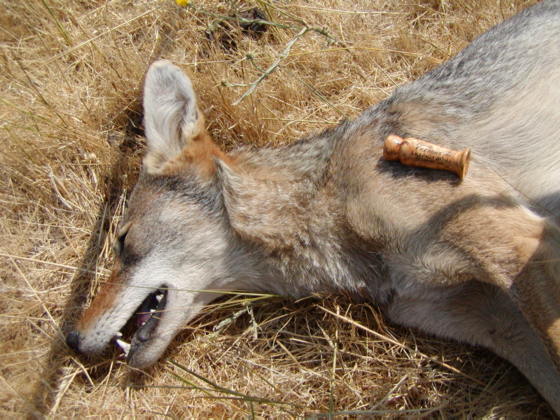
Ladobe's calls sure are quick. Here is a picture of the coyote.
FROM THE SWEETWATER MTNS.... Got a second coyote using the 2K1-22 call in the Sweetwater Mtns near Bridgeport, CA. The elevation was 9000 ft and it was a very hot day. There was a tiny creek at the bottom of the ravine and I setup with visibility of the creek bottom and the thick cover on the hillside above the creek. I was on one of my "Stop & Drop" Hunting/Fishing trips and I had Bart with me. He was setting at my side with a very short leash. Bart tends to run after anything I call in if he is not restrained. I made about 3 series of high pitched calls. (Bart now ignores the calling and begins to watch intently for incoming animals). Bart perked up and focused his attention on one spot across the creek. I look and sure enough, it was Mr. Coyote. The coyote had just come out from the with his head and shoulder exposed. It was an easy shot at about 140 yards. A minute later Bart spotted a badger. He mush have come into the call. I didn't want Bart to tangle with a badger and after Bart barked, the badger started "digging in". He was completely underground in about 30 seconds.
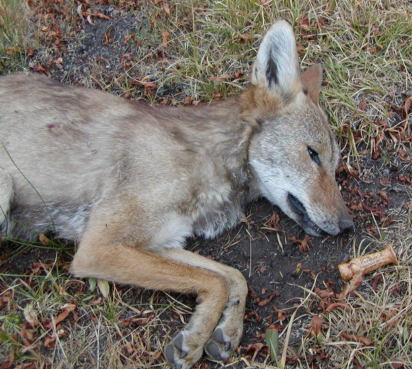
This coyote from the Sweetwater Mtns was in the early stages of
mange or recovering from it. His pelt was very poor. He was very
close to this year's Cannon Fire area, but his whiskers were long,
so he was not singed like I first thought. The coyote didn't look
healthy and I didn't let Bart get close to it. I didn't want Bart
to catch mange.
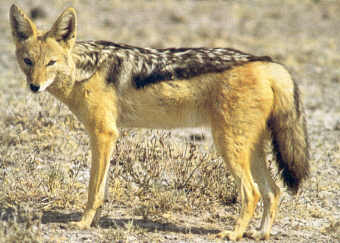 Canis mesomelas
HUNTING "COYOTES" IN AFRICA.... The Jackal is Africa's
equivalent to the coyote in America. There is an excellent site
about calling Jackals in Africa. African
Econo Hunter How we hunt cheap game and varmint (Jackal, our
"coyote") in Africa.
Coyote Attacks on
Children.
Coyotes can cause predation problems for farmers.
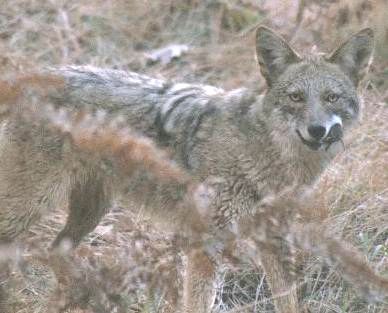
Canis latrans
Coyotes not only eat rodents, they cause serious predation on cattle, sheep, goats, and other livestock.
GAINING HUNTING
ACCESS.... I live 100 miles from the nearest National
Forest or public hunting lands, but I have access to thousands of
acres of hunting land nearby. I can't help other hunters with
access, because most of the areas I hunt I have permission for only
myself. But I can tell you how I gained access to all this land.
Most of the ranchers in my area have had problems with coyotes
attacking and/or killing some of their livestock. Each loss of
livestock is a large loss of profit to their ranching business. I
have learned how to call coyotes. At first I was not very good at
it, but that didn�t stop me from telling the ranchers that I wanted
to help them with their coyote problem. Pick out a rural area where
the ranches are large and far apart. Go to the ranch house and tell
the rancher that you can help him with his coyote problem. Look for
ranch houses that are small and not well kept with large barns for
cattle and horses. That is a working ranch and an indication that
they have lots of land where they run the cattle. Approach the
rancher in a friendly manner and tell him that you want to help
him. This is the time when you present your Hunting Business Card.
Once you get permission plus a coyote or two for the farmer and
gain his confidence and respect, you will probably be the only
hunter with access to that land. This kind of a hunting arrangement
is worth working for. Later, after you remove more coyotes, you can
tell the rancher about all of the other varmints, such as ground
squirrels and wild pigs, that you can help him with. I have yet to
meet a rancher that wasn�t happy for me to thin out the ground
squirrels after I get the coyote population under control.
I got this email from Gary:
Hello Al. My name is Gary. I mailed you last year and told you of a coyote I shot. Hunting season is just starting here in Indiana. I want to thank you for the good advice on reloading and calling. I have down loaded the main coyote sounds and listen to them often. Very few people in my area call for coyotes. By talking to farmers and asking permission to hunt and call after deer season, I have more ground to hunt than I can go to in one season. Will send some pictures maybe. Gary
My coyote hunting "Business Card"

Here is what my new card looks like
BUSINESS
CARD.... To gain better access to hunting areas, treat your
coyote calling like it is a business. When you talk to the farmer,
tell him that you can help him solve his predation problems. I have
made my "Varmint Hunting" business cards using AutoSketch and
lately with PrintMaster Gold. Here is a slimmed down version of it.
Don't be timid with your words. Besides, if you can do it, it isn't
bragging. When you approach a farmer and ask him if he would like
help with his predator and varmint problems, it works wonders to
hand him your card! The "fly-by-night" hunter-plinkers the farmer
has seen in the past don't hand out business cards and they
probably don't have a computer and can't make a card anyway. If you
have the tools, make yourself a varmint hunting business card. You
are welcome to use any of the photos off my web site on your card.
It is well worth the time. I also get the farmer's address and
write to him, giving him hunting reports on my visits to his land.
Here is an important point. The farmer's wife will read the letters
too and you will be making friendships with both the farmer and his
wife. You will become a friend of the family instead of some
stranger with a gun. My ring of padlock keys to farmer's gates is
steadily growing too.
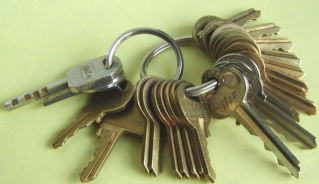
Sometimes it is difficult to remember the correct key
for each gate and I end up having to try a few.
SHOW &
TELL THE FARMER�. When you talk to the farmer, tell him how
you're are going to bring in the coyotes with your call and then
show him. The farmer will almost always have a dog and if you do a
good job with the hurt jackrabbit screams, the dog will come
running. It is very easy to impress the farmer with your calling
skills this way. I also do a couple of coyote howls and depending
on how much experience the ranch dog has had with coyotes it will
get very excited. On a recent outing, we stopped at the ranch house
and talked to the farmer and told him about our successful hunting
results. Some coyote blood had spilled on my boot. While we were
talking to the farmer, his female dog came over and was sniffing
the coyote smell and when I wasn't looking, the bitch (acceptable
canine term) squatted and peed on my boot! Obviously she didn't
like coyotes very well. Later, after the dog had wandered off, I
demonstrated to the farmer how the calls sounded. I made the hurt
rabbit call and the bitch came running up and got very excited.
Then I made a couple of coyote howls and she got even more excited
and started running up the hill after the imaginary coyote. The
farmer was quite impressed with my calling skills. When I got home,
my dog, Oscar, was sure interested in my boot too! He did a lot of
sniffing and I made sure that's all he did.
CAMO.... Well, here is where I am going to disagree with the real pros! I gave up wearing camo while I am hunting. I buy my clothes from Red Head or Cabela's and they are dull, green, brown, and/or gray. I don't want to look like a militia freak wearing full camo to and from hunting. My heavy coat is camo, and my hat is camo, but that's all. With my "blend into a crowd camo", I have called coyotes right up to me. Most of the time I see coyote and deer before they see me. That's a good test of your stealth and color selection. But, here is where I go overboard. I paint my rifle and Bi-Fur-Pod camo! Yes, my pretty rifle with the fancy French Walnut stock (some fiddle back) and the stainless steel Shilen barrel are painted with permanent camo paint. The shine off a rifle barrel is the most obvious indicator to a critter that something bad is out there. Have you noticed that you can spot hunters miles away, just from the flash of sunlight off the shiny rifle barrel. Camo paint stops that! One of my hunting partners had a beautiful Browning 30-06 Semi-Auto and I told him he should paint it. It shined like a diamond up a goat's ass. Well, we were deer hunting and I jumped a nice Blacktail and it headed his way. I called him on a handheld ham radio (we are both ham radio operators) and told him a buck was coming his way. He was 500 yards away, and I could see the flashing reflections off his barrel. That Blacktail went over the hill away from me heading toward my partner. About 5 minutes later, the buck came over another hill off to the side running away from the barrel flashes. I made a nice neck shot and the hunt was over. The next day my partner wanted to know where to get camo paint. You should see his "Beautiful Browning" now!
PAINT YOUR RIFLE.... I painted my deer/coyote
rifle with permanent spray paint. I believe they have a 4 can kit
of camo spray paint at Cabela's. The one I used is Hunter's
Specialties, Inc. Camouflage Spray Paint Kit (permanent). I wiped
the rifle off with a dry cloth to remove most of the oil. I put
masking tape over the scope ends and the numbers on the power
setting and AO settings plus a piece of tape over the end of the
barrel. The bolt was left in the action and in the closed position.
The sling was off. I painted everything I could see. First I
painted a solid coat of the lightest color, which is mud. Then I
painted random areas of green and then areas of brown. I went out
in the yard and picked some leaves off a bamboo plant. I placed the
leaves over the rifle in various locations and then sprayed a very
light coat of the flat black over the leaves. That gives it the
leafy shadow effect. You might want to practice on something before
you start on your nice pretty rifle. I have painted about 6 of my
rifles. It gets a bit better looking, depending on your point of
view, each time I do one. I figured that since I don't want to sell
the rifle, I ought to make it work the best it can for me. The
pretty shiny stock and flashy barrel scare game in the wild. I
mostly see game first now. The camo paint job works great. Way down
under the paint on the Sako is a French Walnut stock with "fiddle
back" grain, but the deer and coyotes don't care about fancy wood.
;-) Check The Gun Garage if you want a professionally
camo job.
MY RIFLE.... My coyote and deer rifle is a 40 year old Sako
Forester action with a new Shilen stainless steel barrel chambered
for a "tight neck" 243 Win. I got it from Herters' as a barreled
action for $75 mail order. The stock was a semi-finished club of
French walnut with a fair amount of fiddle back grain for $15. It
was my first stock job and I wore out the stock screws taking it
apart and putting it back together while inletting it. Then, I did
a stupid thing. I checkered it! It took a month and a whole new
vocabulary of working words! While I was doing it and had it all
messed up, I swore an oath to myself that I would never checker
another stock and I have kept the promise. Finally I glass bedded
it. The barrel is free floating with a generous gap from about 2
inches forward of the action. I gave up trying to make a "tight"
clearance. It seemed like I couldn't slide a dollar bill down the
barrel after a few months, so I made the clearance at least 0.05
inch.
CAMO MAKES IT PRETTY.... A long time ago, I painted the whole rifle/scope camo. It looks very dull and there is no shine off the barrel. In about a year or so, the paint wears down and gets shiny in some areas and then I repaint it. The rifle has about 5 or 6 camo coats on it now and the nice pretty fiddle back wood is down in there somewhere.
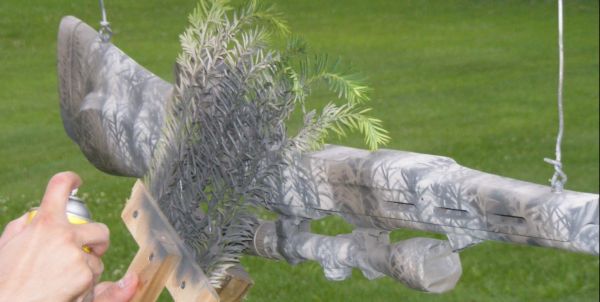
Mark Fields
has painted his rifle and it turned out great. Click HERE to read on how he did his paint job.
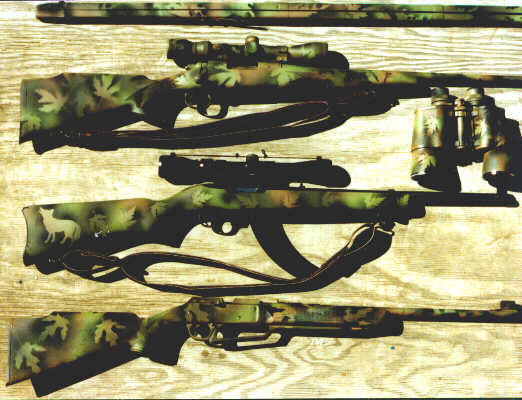
How to Camo By CamoJack: Camo is easy to do. I first clean my Rifle.I use Alcohol. Wipe it down. get any oil off. Close the bolt. You can oil the bolt down and the paint will come off easy, or usually it don't hurt it anyway. Camo your Scope also, I know, it hurts a little. But when your all done, it looks very good. Be sure and tape the ends of the Scope, and any Numbers that you need. Here is the list of Paint I use: "Woodland Camouflage Paint"- "8010-00-111-7937...Mil-e-52798" 1. MUD BROWN..#.30117.--Two Cans.. 2. LIGHT TREE GREEN..#.34258.--One Can.. 3. DARK TREE GREEN..#.34086.--One Can.. 4. FLAT BLACK..Any Good Brand from your Hardware Store. Step 1.-Give the Gun a light coat of "MUD BROWN" (Try to use only two coats to cover the gun) You want to keep your paint job thin so it wont chip or peel. Cover the whole thing, Scope too. Let it set for about two hours before you do the next step. Step 2.- "Spot Spray" Light Tree Green. Just here and there. Let it set about 30 min. Step 3.- "Spot Spray" Dark Tree Green. You can Blend the two Green's together, Where one ends and the other starts, or you can keep them apart. Be sure to not cover up all your Mud Brown. Let it set about 1 hour to dry good. Step 4.- Here is the Trick..Useing the Flat black. Go out and get a good Leaf off your tree. Keep the stem long. You may want a small, and a large one. But you only need to use one. Holding the flat black out, spray a little in the air and notice the spray aim so you don't miss. You might want to practice on a board or something first. Hold the Flat Black spray can about 10 in. From your gun. Hold the stem of the leaf and make sure it lays flat on the area you are spraying. Give it a "Very Light" Touch of Spray. Just to Fade it in. Just covering the Leaf. Turn the Leaf in different directions. Do the Leaf Just here and there. Take a look at my Web Page, I have a picture of some of my guns and Bi-Pod. http://www.jhendrick.com/hunt.html Here is where I order my Paint. http://www.loadup.com/index.html They Ship most of the time in the same day I order. UPS.
Good Luck fromCamoJack.
Drum Click Count for the Tasco 4-16X by 40mm
TR Scope
for 150 to 500 yards.
|
Drum |
150 |
200 |
250 |
300 |
350 |
400 |
450 |
500 |
|
F |
1.5 |
4 |
7 |
10 |
15 |
19 |
24 |
29 |
|
E |
2 |
4 |
7 |
11 |
17 |
24 |
28 |
33 |
|
C |
2 |
5 |
9 |
14 |
19 |
25 |
31 |
39 |
|
D |
3 |
7 |
12 |
17 |
23 |
29 |
37 |
45 |
|
B |
2 |
5 |
10 |
16 |
23 |
30 |
39 |
48 |
|
A |
5 |
9 |
15 |
22 |
29 |
37 |
45 |
|
|
G |
6 |
14 |
25 |
39 |
|
|
|
|
I installed each drum on the scope and counted
the clicks for each yardage setting made the above table.
I use Drum D on
my 243 Win caliber with 100 gr bullets.
I use Drum G on
my 17 HMR with the 17 gr Hornady ammo.
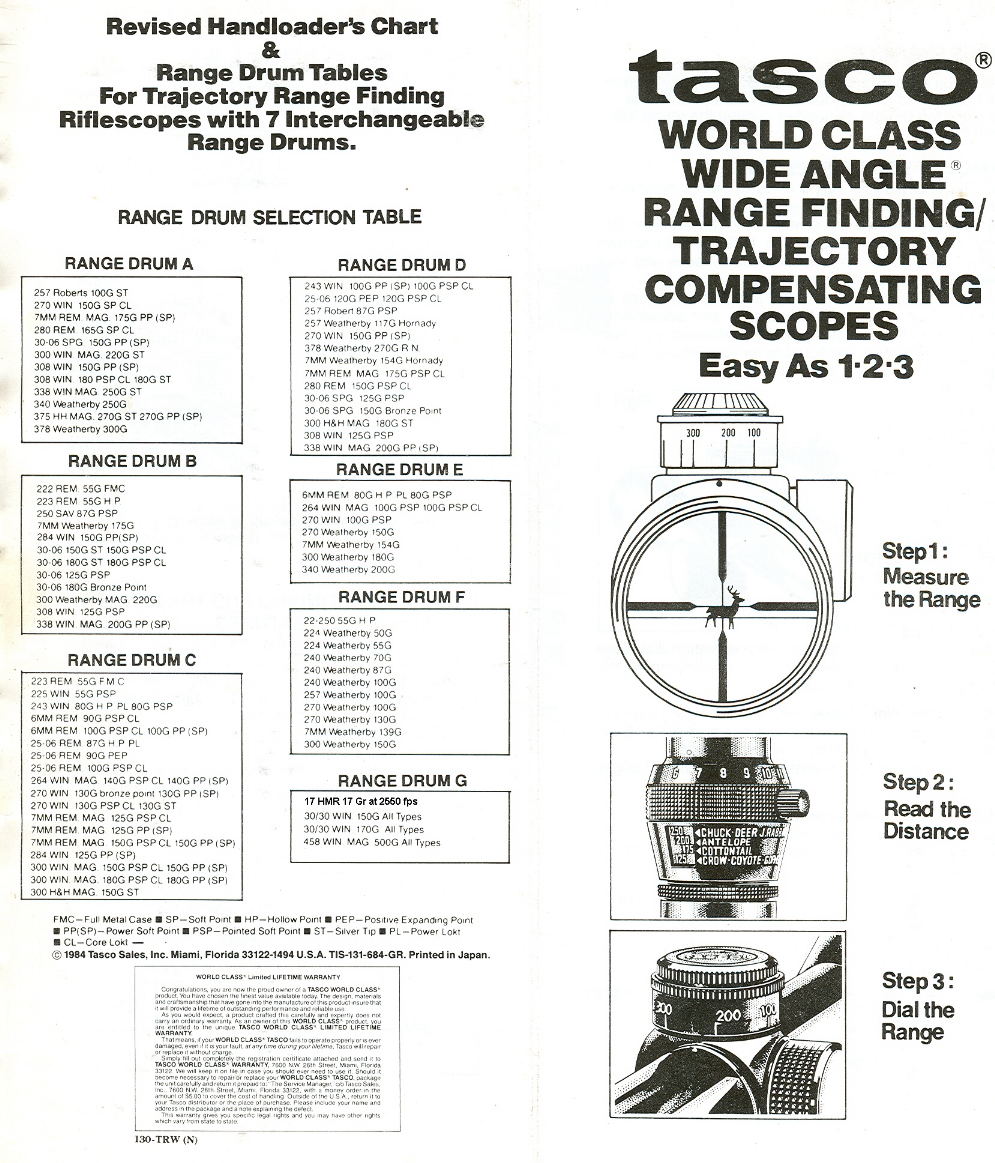
Here is a scanned view of
the Tasco 4-16X by 40mm
TR Scope Drum Tables data sheet.
TASCO TR SCOPE.... The scope is a Tasco TR 4-16X by 40mm with a Trajectory/Rangefinder reticule. The glass is only OK, but the range finder is what makes it my choice! It is a very simple system and works very well. Tasco gives you 5 rings that go on the vertical adjustment knob. Each ring has yardage readings out to 500 or 300 yards in 50 yard increments. They tell you which ring to use for each rifle, but I went one better than that. I wrote a small BASIC program that takes the bullet and velocity that I use and calculates a least square fit to the drop numbers in the Sierra Reloading Manual. I then have a third order polynomial equation for the drop out to 1000 yards. No, I don't shoot that far, but numbers are cheap! Setting zero at 100 yards and using the height of the scope over the bore, the program calculates the number of clicks below the line-of-sight for each range past 100 yards. I counted the yardage clicks on each ring and selected the ring that best fits my calculation. I have a ring that is calibrated within �1 click, of the true drop setting, all the way out to 500 yards for the .243 100 gr. Spitzer at a muzzle velocity of 2900 fps.
ZERO AT 100 YARDS.... I zero the rifle at 100 yards on the benchrest and in the field. I only have two things to estimate for a shot, distance and wind. I also shoot a group off my Bi-Fur-Pod sticks to verify my 100 yard zero for field conditions. Shooting off the sticks gives me the same impact point as I get from the benchrest, but the groups open up a bit because the Bi-Fur-Pod is not as steady.
ESTIMATING THE RANGE.... The scope has dual crosshairs and you can put the coyote between the crosshairs and dial the power until it just fills the height and then read the range on a dial. That is too complicated when you see a coyote and here is what I do in the field. I look in the direction of the coyote and start counting the distance in 100 yard increments. I look for what is 100 yards away from me. Then I look for what is 100 yards from that point, and so on out to the coyote. I am getting pretty good at estimating the range in yards. One of these days I plan to get an 800 yard laser range finder.
DIAL IN THE RANGE.... After estimating the range, I dial the yardage in on the scope vertical adjustment. It is that easy. Windage is more difficult. I have to hold-off for wind. That gets tricky and very difficult across canyons when you can't see the evidence of the wind. I have made some very good shots on coyotes out to 400+ yards in mild wind conditions. I always take all shots off the Bi-Fur-Pod to get a steady hold.
A 50 YARD ERROR.... Suppose I misjudge the range by 50 yards at 400 yards. The error is 5 or 6 clicks and the clicks are 1 inch at 400 yards. So my error is 5 or 6 inches and still within the vital area on a coyote. This is better than using the point-blank method. With the point-blank method, one has to make four estimates: the distance, the amount of hold over in inches required, what the holdover looks like on the target, and windage. It is difficult holding over one foot by guessing how big one foot is at that distance.
POINT-BLANK METHOD NOT FOR ME.... I like my system much better than the "point-blank" method of sighting in where you are 3" high at 100 yards and then right on at 220 yards and 4" low at approximately 300 yards. You don't know where to guess at 400 yards. Maybe hold over a foot or so, but most of all, you know you are going to be off at every range except 220 yards. Knowing that you are always off does bad things to my confidence and confidence is a big part of shooting accurately.
FINDING THE TARGET IN THE SCOPE.... If you have not used
scope sights or have trouble finding the target, here is a tip.
Wrong Way: Put the rifle up to your shoulder and look in the
scope and scan around to find the target.
Right Way: Look at the target and continue looking at it
while you mount the rifle and put the scope in the line of view.
The scope should be nearly centered on the target when it gets in
front of your eye. With just a little practice you will be able to
acquire the target in a fraction of a second. This also works for
binoculars.
 The Remington Model 7
makes a very good starting rifle for varmint hunting. There is an
excellent article about the Rem Model 7, see the links below about
the Rem Model 7. Early on, I used my light weight Rem Model 7 in
223 Rem, shown here, for coyotes, but it was a little too light for
the occasional long shot. The Sako in 243 Win has worked much
better. A number of my rifles have had the camo paint job.
The Remington Model 7
makes a very good starting rifle for varmint hunting. There is an
excellent article about the Rem Model 7, see the links below about
the Rem Model 7. Early on, I used my light weight Rem Model 7 in
223 Rem, shown here, for coyotes, but it was a little too light for
the occasional long shot. The Sako in 243 Win has worked much
better. A number of my rifles have had the camo paint job.
The Remington Model Seven...a great place to start
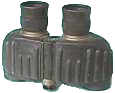 BINOCULARS.... I have a pair of Steiner 6X30
Whitetail binoculars. They have the range finder reticule in the
right side, and I seldom use it. The range finder gets in the way
and if I had it to do over again, I would have opted for a pair
without it. The brightness and sharpness of focus is excellent. The
field of view is very large, being about 450' at 1000 yards. They
are individual focus eyepieces and the depth of field is so great
that, I focus at 100 yards and leave it there. Everything is
in focus from 50 yd to infinity. At the edges of the field of view,
the sharpness of focus fades out and objects there are fuzzy. I use
this to my advantage. If there is a close object, that I want to
view without fussing with the focus, I merely view it at the edge
of the field of view and it is in focus. I have used these
binoculars for deer and coyote hunting. They are even very good for
spotting ground squirrels, but the 6x power is a tad low.
BINOCULARS.... I have a pair of Steiner 6X30
Whitetail binoculars. They have the range finder reticule in the
right side, and I seldom use it. The range finder gets in the way
and if I had it to do over again, I would have opted for a pair
without it. The brightness and sharpness of focus is excellent. The
field of view is very large, being about 450' at 1000 yards. They
are individual focus eyepieces and the depth of field is so great
that, I focus at 100 yards and leave it there. Everything is
in focus from 50 yd to infinity. At the edges of the field of view,
the sharpness of focus fades out and objects there are fuzzy. I use
this to my advantage. If there is a close object, that I want to
view without fussing with the focus, I merely view it at the edge
of the field of view and it is in focus. I have used these
binoculars for deer and coyote hunting. They are even very good for
spotting ground squirrels, but the 6x power is a tad low.
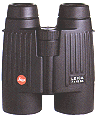 LEICA
8X32BA.... I purchased a new pair of binoculars. I have only
been using them for a few years. (I now use the Leica binoculars
exclusively.) Here is what I have found. The brightness and the
sharpness of focus are excellent. I also focus them at 100 yards
and they are very good from 50 yards out to infinity. But, I have
noticed that I can sharpen the focus with just a minor touch of the
center focus adjustment and I continually fuss with the focus. The
field of view is flat. There is no "bubble" effect in the field of
view when I pan with them. The image is in sharp focus right out to
the edge of the field of view. The field of view is a large 442' at
1000 yards. So far they appear to be superb in every respect. When
they are cold and the air is warm, the eyepiece lenses tend to fog
up, on the outside, when I am looking through them. I also noticed
how poorly the above Steiner binoculars look when I use them after
using the Leicas. I used to look at all the binocular ads in the
catalogs, but have found no need to do that anymore. I am happy
with the 8x32 BA binoculars.
LEICA
8X32BA.... I purchased a new pair of binoculars. I have only
been using them for a few years. (I now use the Leica binoculars
exclusively.) Here is what I have found. The brightness and the
sharpness of focus are excellent. I also focus them at 100 yards
and they are very good from 50 yards out to infinity. But, I have
noticed that I can sharpen the focus with just a minor touch of the
center focus adjustment and I continually fuss with the focus. The
field of view is flat. There is no "bubble" effect in the field of
view when I pan with them. The image is in sharp focus right out to
the edge of the field of view. The field of view is a large 442' at
1000 yards. So far they appear to be superb in every respect. When
they are cold and the air is warm, the eyepiece lenses tend to fog
up, on the outside, when I am looking through them. I also noticed
how poorly the above Steiner binoculars look when I use them after
using the Leicas. I used to look at all the binocular ads in the
catalogs, but have found no need to do that anymore. I am happy
with the 8x32 BA binoculars.
HUNTING GEAR I
CARRY.... I want to be self sufficient when I am out
deer hunting, so I carry a lot of gear, but it is not heavy or
bulky. I carry my Sako Forester in 243 Win topped with a Tasco
4-16X Trajectory Rangefinder scope mounted with Warne rings. There
are 3 rounds in the magazine and one in the chamber with the safety
on. When back at camp, I push the round that was in the chamber
down into the magazine and close the bolt on an empty chamber. The
rifle has a nonadjustable carrying strap that is relatively short
and holds the rifle close to my back in a vertical position on my
shoulder. I don't like a loose floppy sling. I carry a pair of
Leica 8-32 BA binoculars around my neck on a relatively short strap
so they don't swing when I walk. On my belt are my Bi-Fur-Pod
shooting sticks that I use for almost every shot. I very seldom
take a running shot at deer or coyotes.

I carry a Russell FeatherLite Knife with a Clip Point Blade K-93B
AUS-8A in my pocket. It is very light and holds a good edge
very well.
FANNY PACK.... I carry a two compartment camo
fanny pack that weighs about three pounds fully loaded. There is a
picture of it with my calls on this page. The top
compartment has a couple of Power Bars in it in case I get hungry
and a rolled up plastic rain coat only in wet weather. This
compartment opens up to a daypack size to hold my coat if it gets
too warm after sunrise. I drink a lot of water before I leave camp
and do not carry a noisy water bottle. The main compartment carries
a lot of important gear:
HIGH TECH GEAR.... Some hunters like the minimum
amount of gear, but I like to be well equipped. I studied hard to
learn the technology and Morse code to get my Ham license. I don't
feel a bit bad about using the radio to stay in contact while
hunting. All of the hunters in our party have their licenses and
ham radios. Most also have GPS units. We don't have to worry about
anyone getting lost even on overcast days in the thickest of
timber. When I head out hunting I like to feel completely self
sufficient. With the GPS, I can head into the wind no matter which
direction it is or when it changes. Then when I want to return to
camp, I can take a direct route back. One other very handy feature
is that I can call back to camp on the handheld radio and get a
ride back to camp. I can tell them my location with the GPS even if
I am a long way out and it is dark. It is also very easy to mark a
particular spot and return to it with the GPS or tell one of the
other guys in the party my exact location. The GPS unit gives the
hunter freedom to go much farther than when one has to worry about
remembering his backtrack.
Another feature of the GPS unit is that before the season opens, I
mount the unit in my truck and drive all of the roads in the area
and create a track file of the roads. I also can upload the file to
the other units in camp with the laptop computer. Having the roads
on the GPS unit makes it very handy to avoid roads when out
hunting. Then it is very useful to know where the nearest road is
when you get a deer down or want a ride back to camp. I view
hunting as an enjoyable sport, not a time for punishment.
CALLING HOME.... I also take a laptop computer on
hunting trips. I have a portable packet station that I can set up
and can send/receive messages home to my wife Mary Ann, who is also
a ham, right from most deer camps. There is more info on my
Ham Radio Page. Many people use cell phones
for this purpose, but the packet station works fine. It is
comforting to know all is well at home. When I am coyote hunting on
day hunts I am usually not far from the truck and I don't carry the
GPS unit.
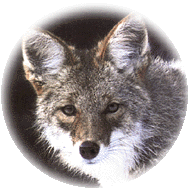
Deer Hunting Techniques with
Sounds
COASTAL BLACKTAIL DEER.... I have hunted these fine California deer for many years. They are not as large as Mule Deer or Whitetail Deer. In the area south of Livermore, a 125 pound buck is large with the average being nearer to 100 pounds. One can find a wealth of information about Whitetail and Mule Deer, but very little on the Blacktail Deer. Here are some of my observations over the years on hunting Blacktails and Blacktail behavior. Here is another site that has information on Blacktail Deer Hunting Blacktail Country.
WHERE ARE THEY.... The bucks normally stay within 10% of the top of the ridges. Very seldom will you find them in the bottom of canyons down near the creek beds. Out here in California during deer season, it is usually very dry and there are deer flies. The bucks like to be as far as possible from the flies and in what little wind there is. The strongest winds will be at the ridge tops. The bucks are essentially nocturnal and will feed at night. They will continue to feed in the mornings from dawn to sunrise. After sunrise they will lay down in the shade for the rest of the day. In our area, we carefully check the shade of every tree on the far hillsides with a spotting scope. The bucks will get up and start to feed at sunset and come out into the open.
BACHELOR HERD.... The bucks stay in a bachelor herd of 2 to 4 bucks and do not associate with the does until late September when the rut starts. The California A-Zone hunting season opens in early August and closes in mid September before the rut starts. A forked horn Blacktail Buck is a mature deer and often as the buck ages, his forks only become larger but he stays a forked horn. Occasionally they will add another tine on the forward fork and become a 3x3. I have yet to see a 4x4 Blacktail Buck in the range where I hunt. The spike bucks sometimes will stay with mother. When you see a bunch of does it is very seldom that a legal buck (forked horn or better) will be with them. The bucks are usually a dark gray color with a black forehead and the does tend to be more of a brownish color.
HUNT THE MORNINGS.... Don't sleep in. The very best time to be out hunting is dawn to sunrise. The bucks will be out in the open feeding and you can spot them from a distance. You might also get lucky and crest a ridge and spot one before he sees you. After sunrise, the bucks will bed down and only stand up every few hours for a couple of minutes and then bed down again. At these times, I find a good observation point and use the binoculars to check for bedded bucks in the shade of the oak trees.
TEACH YOURSELF TO
SEE MORE BUCKS.... Have you noticed that some people just tend
to see more deer than others. The people who see more deer know
it's a deer when they see one or even a small part of the deer.
This is not for the casual hunter, but you can train yourself and
your eyes to see more bucks. Here is how I did it. I had kept a lot
of old issues of hunting magazines. I went through about 3 or 4
years worth of back issues and cut out all of the pictures of Mule
Deer Bucks and Blacktail Bucks. I made a montage about 4 ft. square
of the buck pictures on my office wall where I couldn't miss it
when I looked up from the desk. There were about 40 pictures of big
bucks and a few does from almost every angle. Looking at this
montage for 11 months out of the year, imprinted in my mind's eye
the form of big bucks in the wild. It has trained me to spot bucks
very quickly and it has helped me to spot deer when other people
only see brush and trees. Besides it was fun to look up at the wall
and think about seeing one of those Big Bucks live. As an
afterthought, I guess if you wanted to make sure you could spot a
beauty on a sandy beach, you could make a second montage from old
photo magazines like "Plai-boys". Note: I found out that the PC
police will remove my page so young hunters can't read it if I
spell the magazine name correctly ;-)
Hurt fawn with the Dan Thompson PC-2 Coyote
Call.
Doe warning cough
Hurt fawn with the Burnham
Brother's D-4 Deer Call
Fawn bleat with a single reed diaphragm
Hurt fawn with old unnamed wooden call
 CALLING DEER.... The Burnham Brothers' D-4 Deer
Call works very well. Sometimes you can actually call in a doe or
two. They will come toward you stiff legged and stamp their front
feet at you. They will also cough at you. The cough is a sound like
this and is a danger alarm to other deer in the
area. I have not heard a buck make the cough sound. I have never
called in a buck and had him come running toward me like a coyote
does. Here is how the deer call actually works. When any bedded
bucks hear the call, they will stand up. If you continue to call,
they will usually walk or run toward heavy cover. I get to a good
observation point where I suspect that bucks are bedded out of
sight. I blow a single hurt fawn series with the D-4
Deer Call. Then get ready for action. If you rouse a doe or two,
there will probably not be any bucks around. Here is another good
wooden deer call I got from Wing Supply a few
years ago.
CALLING DEER.... The Burnham Brothers' D-4 Deer
Call works very well. Sometimes you can actually call in a doe or
two. They will come toward you stiff legged and stamp their front
feet at you. They will also cough at you. The cough is a sound like
this and is a danger alarm to other deer in the
area. I have not heard a buck make the cough sound. I have never
called in a buck and had him come running toward me like a coyote
does. Here is how the deer call actually works. When any bedded
bucks hear the call, they will stand up. If you continue to call,
they will usually walk or run toward heavy cover. I get to a good
observation point where I suspect that bucks are bedded out of
sight. I blow a single hurt fawn series with the D-4
Deer Call. Then get ready for action. If you rouse a doe or two,
there will probably not be any bucks around. Here is another good
wooden deer call I got from Wing Supply a few
years ago.
SEEING MORE
DEER.... This year we hunted the C1-Zone in Northern
California. The area where we were hunting did not have very many
bucks, but we saw a lot of deer. Here is how I would see a dozen or
more deer every morning. First, it was hot and dry and very
difficult to move quietly. I would do my best at quiet walking for
about 300 yards until I could find an opening where I could see 50
to 100 yards. I would setup with my rifle on my Bi-Fur-Pod and get
out the Dan Thompson PC-2 Coyote Call. I would make about 6 to 10
fawn bleats that sound like this. The deer in the area
would come running. They came in making a lot of noise. A couple of
times, they got so close, I had to stand up or be run over. The
does often would stamp their front feet and sound a warning
cough at me. Since the area didn't have any large
bucks, I don't know how it would bring them in. But, this technique
would sure bring in what deer were there.
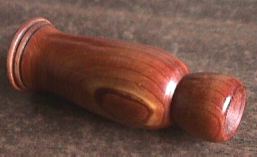 |
Dan Thompson Game Calls
PC-2 Coyote Call |
There were numerous mountain lion tracks in the area and
it was a little spooky making sounds like a hurt fawn and I did
watch all areas of approach very carefully. I was lucky and did not
have any of the mountain lions answer the call. The call was
working so well on bringing in deer, that on several occasions,
after I had spooked deer while walking and heard them bound away, I
could stop, setup, and call and bring them back. Also if you see
one deer and you think there might be more, this calling technique
would bring in the one deer and any other deer in the immediate
area. As a side benefit, you also might bring in a coyote with this
method and do a little depredation work to save young deer and
antelope during the next spring.
MuleMaddness.com Photos, Stories, Deer Info.
NEW BARREL FOR MY SQUIRREL RIFLE.... The new barrel arrived from Bullberry for my Contender Carbine, 3/22/2. It is chambered for the new 17 HMR (Hornady Magnum Rimfire). Click here for the first field testing of the 17 HMR, including accuracy/velocity measurements. It is a T/C Contender Carbine with a Bullberry stainless steel barrel, full bull, 22" long and bead blasted to eliminate the shine. The wood is also by Bullberry. The base is a 92A Weaver base. The Rings are the KWIK-SITE KS-WEV-H rings and the scope is a 15X Weaver CKT-15. The new caliber makes a very nice varmint round with a mild report and is effective out to 150 yards or so. Soon, I will shoot some groups from the benchrest and post a report here. Click here for a large picture of the rifle.
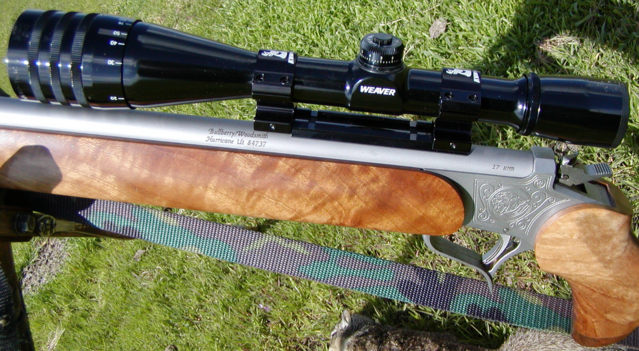
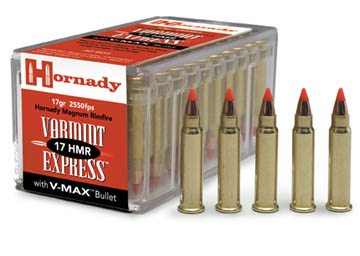
Here is a picture of a box of ammo.
Midsouth Shooters Supply Is taking orders for
the new 17 HMR ammo.
RODENT CONTROL.... Various rodents cause farmers problems and varmint hunters are willing and able to help with very specific rodent control. Here in California, the rodent that causes the problems is the ground squirrel. I have never hunted ground hogs or prairie dogs because they are not found here and I have no firsthand information on them. There is more on ground squirrel hunting on my Varmint Hunting Page.
| I WALK A VERY FINE LINE.... I am very careful to only "control" the ground squirrel population. I have to walk a very fine line. If I shoot too many, they might not survive and the field will be barren. If I leave too many in the field, the rancher might use poison and kill them all. A surviving population of ground squirrels is a good thing and besides, I don't want to work myself out of a job. The same goes for coyotes. |

If you want to link to my page, the URL is:
http://www.varmintal.com/ahunt.htm
If you want a Logo for the link on your page, right click on my
Varmint Al's Hunting Page logo above and save the valogo.gif file
to your hard drive.
Let me know you have made the link and I will link to your web
page.
Hunting Links
Good Hunting... from Varmint Al