
Esten's Tuner
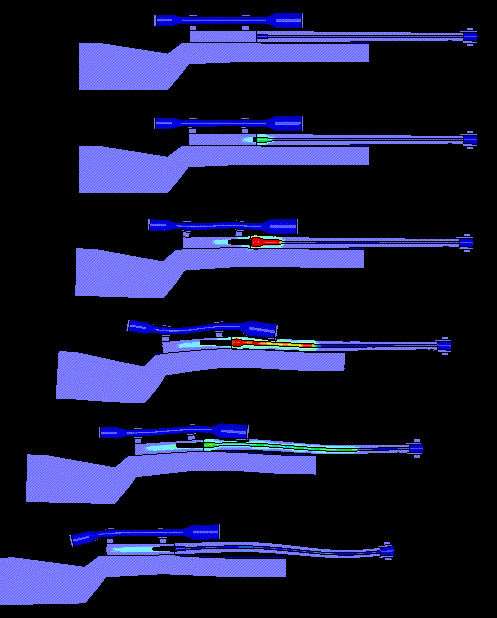
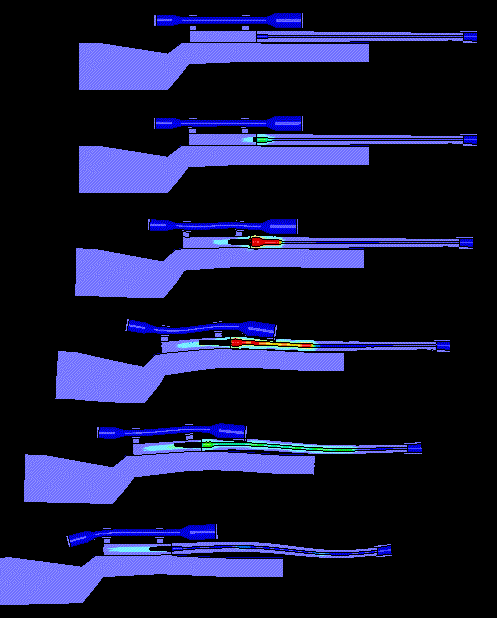
Distortions amplified by 500X.
OBJECTIVE.... The objective of this study was to compare the FEA calculation results using the 3D model of the rifle to Test Data on an accurate benchrest rife. The dynamic response calculations gives some insight and understanding on what a tuner does to the motions of the rifle barrel and how a muzzle tuner might affect the accuracy of a rifle and Point of Impact (POI). The calculation loads simulates the gas pressure traveling up a rifle barrel behind the bullet. The deformations in the rifle and barrel are calculated and then a 100 yard projection of the barrel's muzzle is displayed. The FEA results are then compared to test data for four different loads of N-133 powder and the resulting average muzzle velocities.

SUMMARY.... For the reader who doesn't want to wade through all the
discussion here is a summary of what a tuner can do to correct for small
variations in muzzle velocity from round to round. The Muzzle Projection Curve
shows where the muzzle is pointing at a 100 yard target while the rifle is being
fired. The most important aspect is the curve is where the muzzle is pointing at
the time the bullet exits the muzzle.
Improving accuracy by compensating for small variations in muzzle velocity.
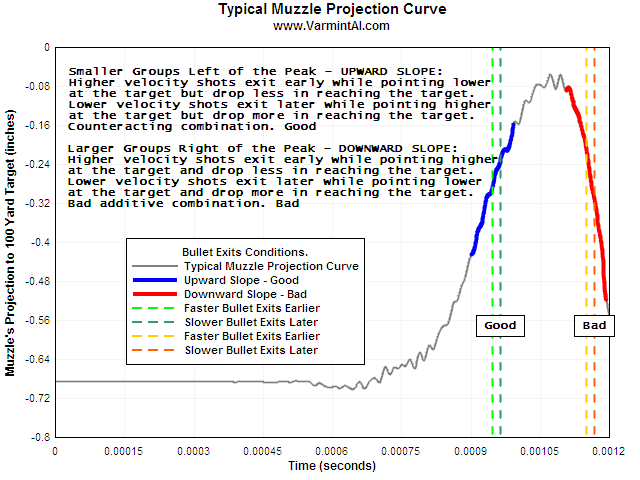
Smaller Groups Left of the Peak - UPWARD SLOPE:
Higher velocity shots exit early while pointing lower at the target but drop
less in reaching the target.
Lower velocity shots exit later while pointing higher at the target but drop
more in reaching the target.
Counteracting combination. Good.
Larger Groups Right of the Peak - DOWNWARD SLOPE:
Higher velocity shots exit early while pointing higher at the target and drop
less in reaching the target.
Lower velocity shots exit later while pointing lower at the target and drop more
in reaching the target.
Bad additive combination. Bad. This is currently being called "Negative
Compensation".
The additional mass of a Muzzle Tuner slows down the muzzle movements and allows
the bullet exit before the peak of the muzzle projection curve during the upward
slope without resorting to high pressure loads.
POWERFUL TOOL.... This analysis was done with the LS-DYNA Finite Element Code. This software is a very powerful tool for analyzing the dynamic and static loading of structures. It was used here to calculate the rifle's response to the high pressure gas that forces the bullet out of a barrel when it is fired. For the first calculation, the breach end of the barrel was fixed in space which treats the barrel as a cantilever beam. The results showed that a more complex model was required to capture the dynamics of the complete rifle. There is a vertical plane of symmetry in the model and only motions in the vertical direction are calculated. In the movies, the displacements are greatly amplified so that they can be viewed.
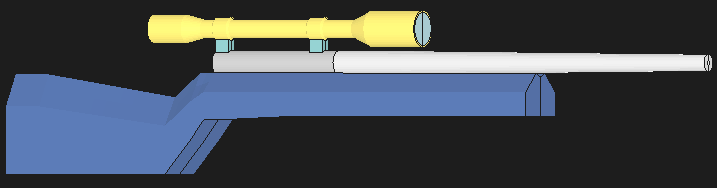
THE BARREL.... The 416 Stainless Steel 5.39 lb barrel in this model has a breach diameter of 1.24" for one inches and then a straight taper to a diameter of 0.935" at a distance of 21". The diameter is 0.935" x 32 tpi from there to the end of the barrel at 22". The caliber is 6mm with no rifling modeled. The 416 Stainless Steel tuner base weighs 7 oz.. The 7 oz brass weight is threaded and can be positioned at various locations on the tuner base. The full rifle is in a one G gravitational field to simulate earth's gravity. The muzzle sag is calculated at the start of each calculation with the Implicit method using dynamic relaxation . Then the dynamic calculation proceeds with the pressure time data using Explicit method. The burning powder's gas pressure is applied to the chamber walls and the bolt face. The barrel's chamber is the size of the 6PPC caliber brass. But for the calculation, I did not include the brass case and merely applied the pressure to the bolt face and the chamber walls.
THE ACTION.... The action is 1.25 inches in diameter and is 7.2 inches long. The weight of the action is 1.5 pounds. The bolt is merged into the action's cylinder. The gas pressure acts on the bolt face. Since there is no bolt, there is also no bolt handle.
THE SCOPE AND RINGS.... The scope weighs approximately 20 oz and is aluminum with a 0.1 inch wall thickness. There is a simulated lens in both the eyepiece and the objective to stiffen the otherwise open ends. The scope rings are also aluminum and are bonded to the action and scope. For the calculations, the scope is only for adding the additional mass in the correct location. The axis bore is projected to the zero point with zero gravity. Once gravity is applied, the muzzle sags and the model's scope is also pointing lower by about 0.003" more with the tuner base and brass weight than it does with the bare barrel.
THE STOCK.... The stock has the mechanical properties of wood. The action is "glued in" to the stock and the barrel is completely free floated. The stock is supported at two places, one 2" section near the butt and another 2" section on the forearm. The complete rifle is allowed free recoil, that is no shooter's shoulder is modeled. The stock in the model is more bulky that the actual stock. The decrease the rigidity of the model's stock, the modulus was reduced by 25%.
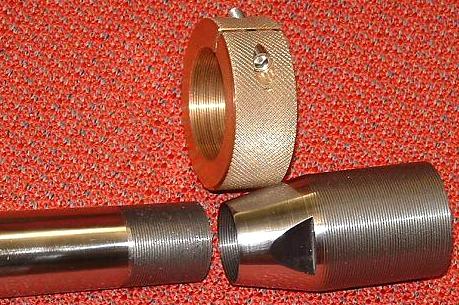
THE TUNER.... The tuner base is screwed onto the barrel and butts up against the muzzle. It weight approximately 7 ounces. The 7 ounce brass weight is threaded so its axial position can be changed. Once positioned, the brass weight is prevented from moving by tightening the clamp screw.
Esten's Rifle
Weights in the Model
(Actual Rifle Weight + Tuner
+ Weight is 12.13 lb)
| 1 5.389 lb 86.227 oz Barrel 2 1.502 lb 24.038 oz Action 3 3.024 lb 48.389 oz Stock 4 1.248 lb 19.966 oz Scope 5 0.053 lb 0.842 oz Scope Mounts 6 0.016 lb 0.249 oz Scope Lens 7 0.431 lb 6.902 oz Tuner Base 8 0.429 lb 6.858 oz Brass Weight -------------------------------- 12.092 lb 193.470 oz Total Weight |
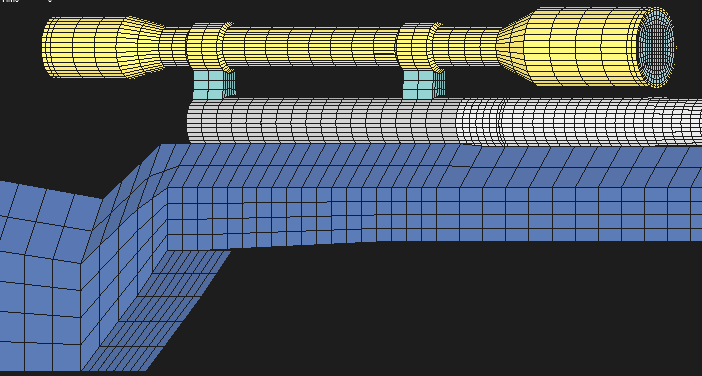
THE 3-D MESH.... This view shows the mesh detail. Only half of the mesh is actually in the calculation. There is a vertical plane of symmetry (X-Z Plane) down the bore axis and the center of the stock. The mesh is reflected across this plane for the for this 3-D mesh picture. The boundary condition for the calculation forces all nodes on the symmetry plane to remain on the plane, but the nodes are allowed to move while remaining on the plane. For the 3-D model without a tuner, there are 17,196 nodes and 12,080 elements. For the model with the tuner base and weight, there are 19,404 nodes and 13,592 elements. Every microsecond of pressure vs time data, the conditions of the model were stored for post-processing to generate the curves. Each shot calculation takes about an hour to setup and run and the stored data requires about 2.5 Gb of hard disk space. An hour is plenty of time for the FEA barrel model to "cool down" in between shots. Then more time is involved in post processing the results so that the results may be compared to test data.
| CONCLUSION.... Maybe the "consensus" was that a rifle barrel vibrated in one or more of the mode shapes when fired. That was because the mode shapes and frequencies were easy to calculate and they did seem to answer some of the questions. From these FEA dynamic pressure calculations, it appears that the recoil and forced deformations are much more important than the natural vibration modes in determining where a barrel is pointing when the bullet exits the muzzle. Then after the bullet exits the muzzle, the rifle barrel vibrates in its various natural frequencies and mode shapes. Put another way, consider a guitar string being plucked. One pulls the string into a position (forced position) then releases it and the string vibrates at is natural frequency. The recoil and bullet motions "pulls" the rifle barrel to a new shape and once the bullet leaves the barrel, then the barrel vibrates. However, the addition of the scope to the model has shown some small high frequency vibrations superimposed on the forced deformations, both of which, slightly alter where the muzzle points before the bullet exits. For lowering the amplitude of the high frequency vibrations, it appears that even an "out of tune" tuner is better than no tuner at all. |
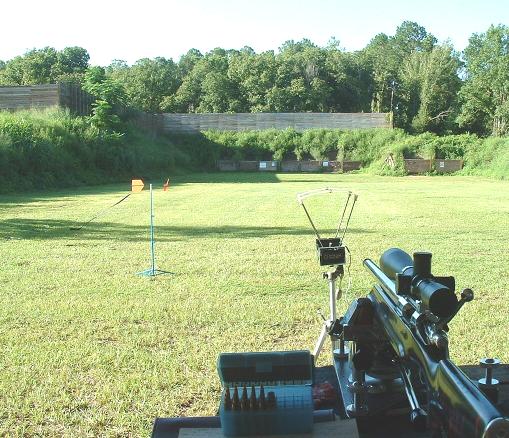
ESTEN'S TEST SETUP.... The chronograph is 4 ft in front of the muzzle.
Beautiful place to shoot groups!
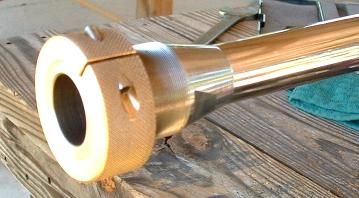
Tuner Weight in the forward position.
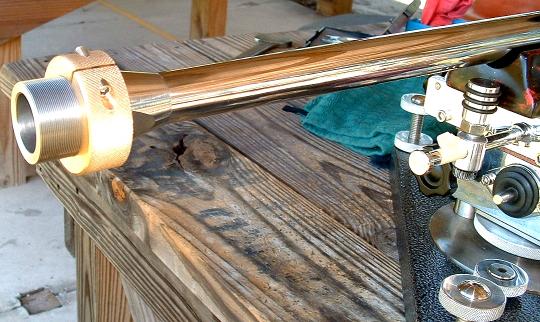
Tuner Weight in the rearward position.
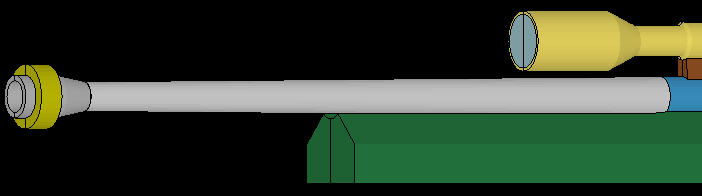
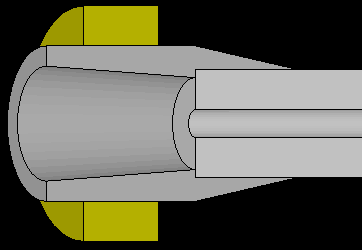
FEA MODEL OF THE TUNER.... Here is a view of the FEA model with the brass
weight in the center position. The second view shows a cut-away view so the
details of the inside of the tuner base can be seen. In the FEA model, the tuner
base and brass weight are not threaded but are bonded to each other by merging
nodes of different materials.
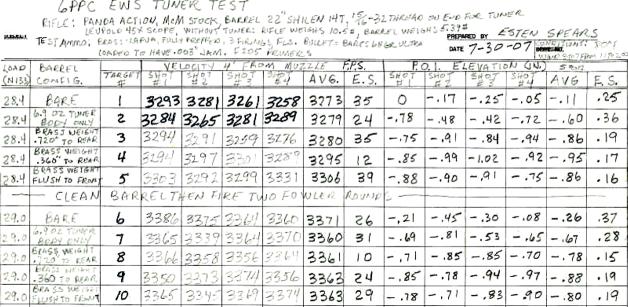
TEST DATA 1.... Here is Esten's Test 1 Data taken at the range. During
the test, the scope was NOT adjusted.
Table: Test 1 Data Summary
| Barrel Condition | Average Muzzle Velocity (fps) |
Average Measured Point of Impact (in) |
| Bare Barrel | 3287
28.4 gr N-133 |
-0.11 |
| Tuner Base | -0.60 | |
| Tuner Base + Weight (rear) | -0.86 | |
| Tuner Base + Weight (center) | -0.95 | |
| Tuner Base + Weight (forward) | -0.86 | |
| Bare Barrel | 3364
29.0 gr N-133 |
-0.26 |
| Tuner Base | -0.67 | |
| Tuner Base + Weight (rear) | -0.78 | |
| Tuner Base + Weight (center) | -0.88 | |
| Tuner Base + Weight (forward) | -0.80 |
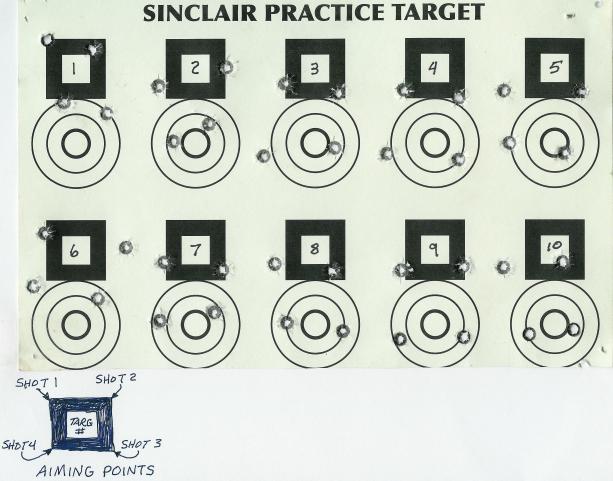
TEST TARGET 1.... Here is Esten's Test 1 Target and the aim points he
used. During the test, the scope was NOT adjusted.
Comparison of Pressure vs Time Data
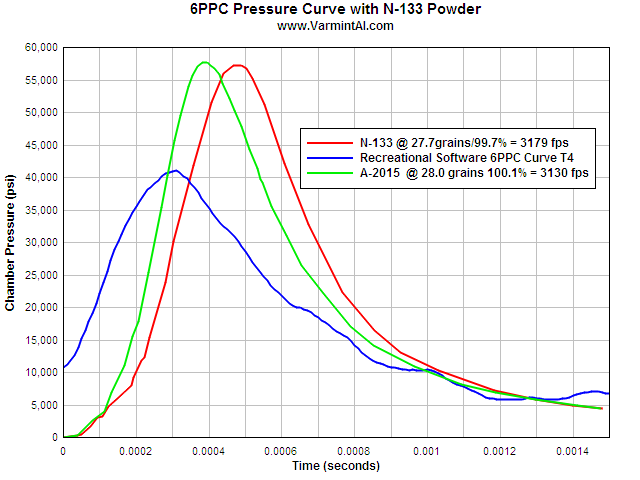
PRESSURE CURVES COMPARED.... The calculations were done with two
different pressure curves. I received the N-133 pressure curves after I had
already done the calculations with the RS curves. Esten was using N-133 rifle
powder in the test. The N-133 powder has a much narrower and higher peak
pressure than the Recreational Software data with a generic powder that is not
specified. The RS data also starts at zero time with a pressure of about 10000
psi. The N-133 data has a zero pressure at zero time.
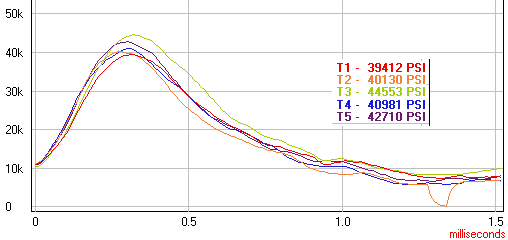
6PPC PRESSURE CURVES.... I received permission form Recreational
Software, Inc to use their 6PPC Pressure vs Time data. I downloaded the Free
Pressure Trace software in demo mode. Included in the download is the sample
five shot pressure vs time curves for a 6PPC out of a clean cold barrel shooting
the 70 gr Nosler Ballistic Tips (Moly) bullets. I was able to extract the 249
points of digital data from the file for each of the five curves. I create 5
separate pressure loading curves for the Finite Element model of the full rifle.
The T4 curve was scaled to give a muzzle velocity of 3287 and 3364 fps.
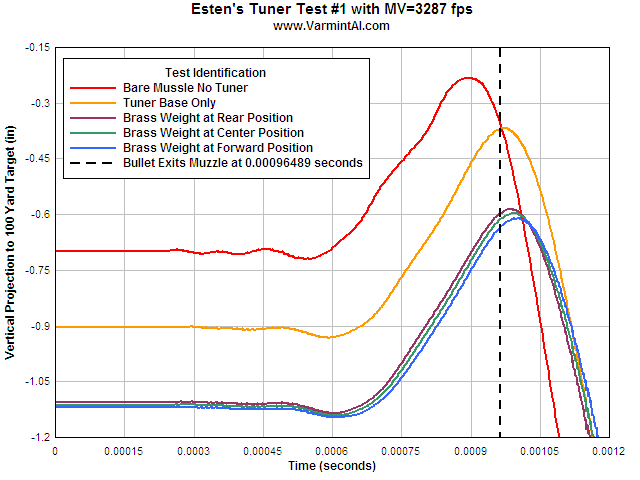
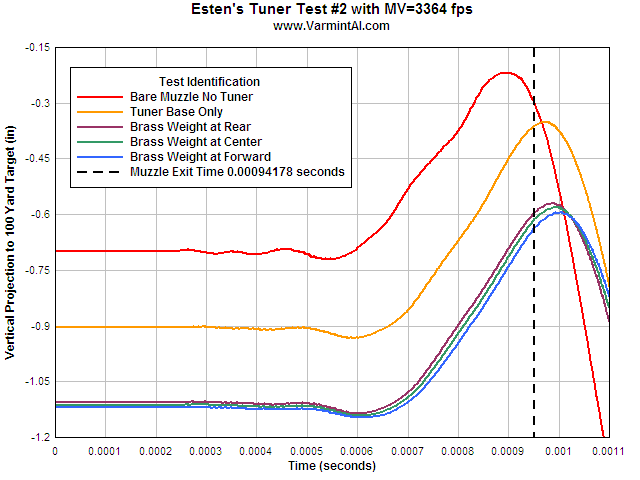
RECREATIONAL SOFTWARE CURVES.... The results with these pressure curves
are much different than the pressure curves from N-133 powder data. I am showing
them here to indicate the difference that pressure curve data can make on the
calculations. With the RC pressure curves, one would have to use a tuner or
shoot a very high pressure load for the muzzle exit time to occur before the
peak in the muzzle projection curve.
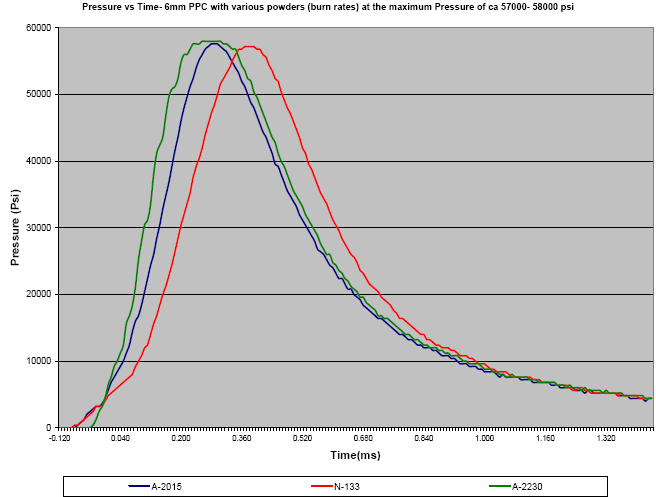
PRESSURE CURVE.... Ralph Stewart got these pressure curves from Johan
Loubser, Ballistician at Western/Accurate Powders. Apart from the N-133 Johan
also included Accurate-2015 and the Accurate-2230 Spherical powder as a
comparison.
The respective charge mass loading density (%) and velocities were as follows
from a 24” barrel:
N-133 27.7 grains 99.7% MV =
3179 fps.
A-2015 28.0 grains 100.1% MV = 3130 fps
A-2230 30.5 grains 98.2% MV = 3304 fps
N-133 PRESSURE CURVES.... The N-133 curve was scaled to generate muzzle velocities of 3287 and 3364 fps in a 22 inch barrel to duplicate the average muzzle velocities that Esten measured during the Test 1 testing. Later the curve was scaled to duplicate the muzzle velocities of each 4 shot group in Test 2.
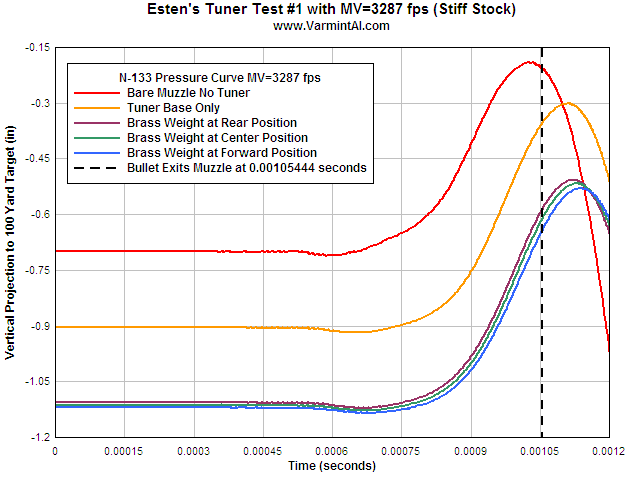
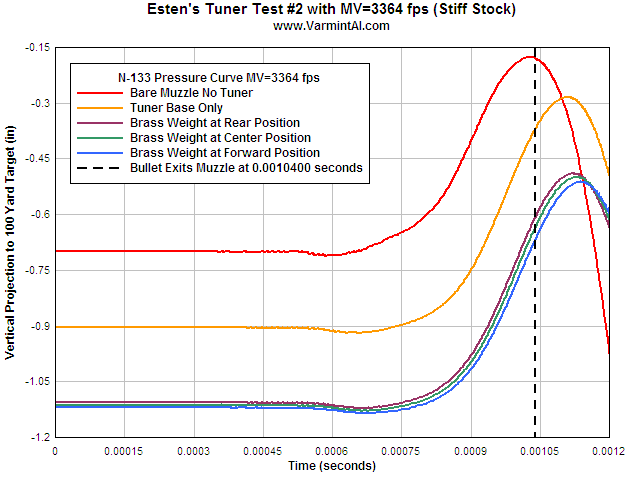
MUZZLE PROJECTION CURVES.... With the stiff stock the projection to the
100 yard target is quite different using the N-133 pressure curve data and
scaling it to the average muzzle velocities measured in the test. The first
thing one notices that the muzzle exit time shifts leftward coincides with the
muzzle's peak pointing position. The generic pressure curve had the muzzle's
projection on a downward swing at muzzle exit time. It looks like a high
pressure load with N-133 puts the muzzle exit time on or near the left side of
the curve's peak even without a tuner. The point of impact results did not match
the test data very well. It was possible to normalize the FEA model and relax
the stiffness of the stock to improve the calculation's accuracy.
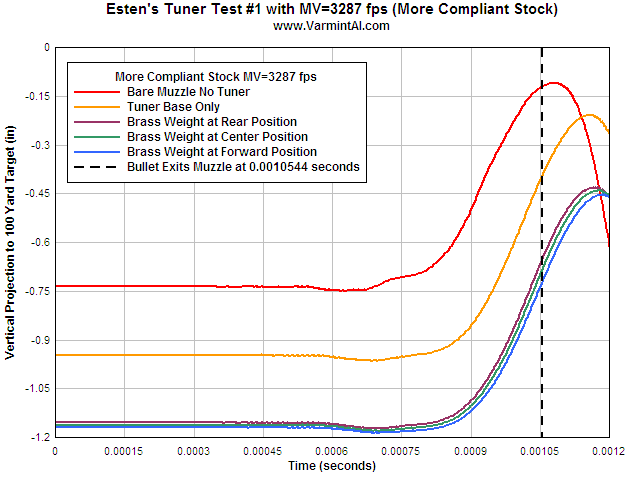
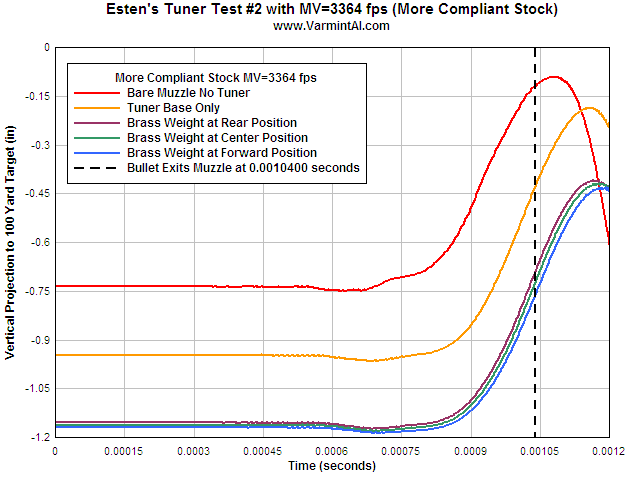
MORE COMPLIANT STOCK.... The "clubby" rifle stock in the FEA
model appears to be too rigid compared to Esten's rifle stock. The elastic
modulus of the hard wood stock was reduced by 25% to make it more compliant. The
point of impact results with this more compliant stock are a better match to the
test data. The FEA model with the more compliant stock appears to be a
reasonably good representation of Esten's rifle.
Dynamic Movies of Deformations Amplified 500X
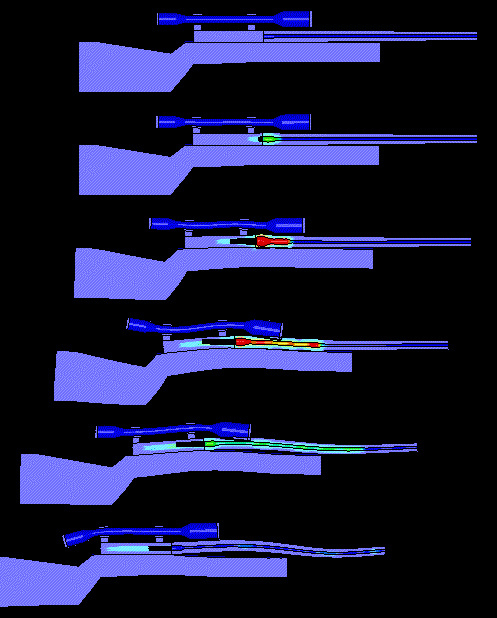
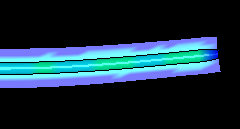
BARE BARREL.... The movie shows the gas pressure traveling down the
barrel at 1/4" increments for the 3365 fps muzzle velocity. The pressure
was applied with 82 separate pressure curves with the arrival time of the
pressure calculated from the bullets movement. The deformations are amplified by
500X so one can see the movement. The muzzle is at the top it its swing when
projected to the target but it has a downward velocity that is transmitted to
the bullet as it exits. The still picture is the muzzle just as the bullet is
about to exit. The muzzle sag from gravity was not included in these movies to
more clearly show the movement. Note that the bolt moves aft a few mils from the
chamber pressure. See Panda Bolt Page. When the few mils
is amplified by 500X, it looks like a big hole in the receiver.
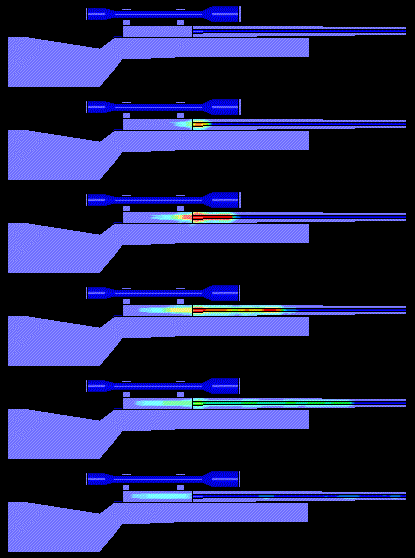
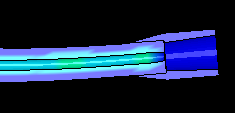
SAME MOVIE AT 1X.... This is the same movie as above, but the deformation
are shown at 1X.
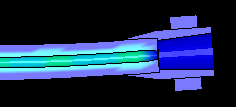
BARREL WITH TUNER BASE.... The movie shows that with the Tuner Base the
muzzle projection is still climbing at bullet exit time.
BARREL WITH TUNER WEIGHT CENTER.... The extra weight slows down the
motions and the muzzle projection is still climbing but quite a bit below the
maximum upward swing.
 Watch
the scope's motion on this 50 caliber on YouTube.
Watch
the scope's motion on this 50 caliber on YouTube.
The scope needs to be strong to survive a 50 caliber!
Springfield
M1A High Speed Video.
Watch the barrel's forced deformations. After the bullet has left, then the
barrel vibrates.
Table: Test 1 Data Summary & Calculation Results
| Barrel Condition | Average Muzzle Velocity (fps) |
Average Measured Point of Impact (in) |
Test 1 POI Shifted for Average of Zero (+0.677)* |
Calculated POI Shifter for Average of Zero (+2.1951)** |
| Bare Barrel | 3287
28.4 gr N-133 |
-0.11 | 0.567 | 0.2843 |
| Tuner Base | -0.60 | 0.078 | 0.0750 | |
| Tuner Base + Weight (rear) | -0.86 | -0.183 | -0.1949 | |
| Tuner Base + Weight (center) | -0.95 | -0.273 | -0.2435 | |
| Tuner Base + Weight (forward) | -0.86 | -0.183 | -0.2973 | |
| Bare Barrel | 3364
29.0 gr N-133 |
-0.26 | 0.417 | 0.4013 |
| Tuner Base | -0.67 | 0.007 | 0.1187 | |
| Tuner Base + Weight (rear) | -0.78 | -0.103 | -0.1515 | |
| Tuner Base + Weight (center) | -0.88 | -0.203 | -0.1963 | |
| Tuner Base + Weight (forward) | -0.80 | -0.123 | -0.2495 |
* Each Test POI has 0.677 added to make the average POI = 0.0
**Each calculated POI has 2.1951 added to make the average POI = 0.0
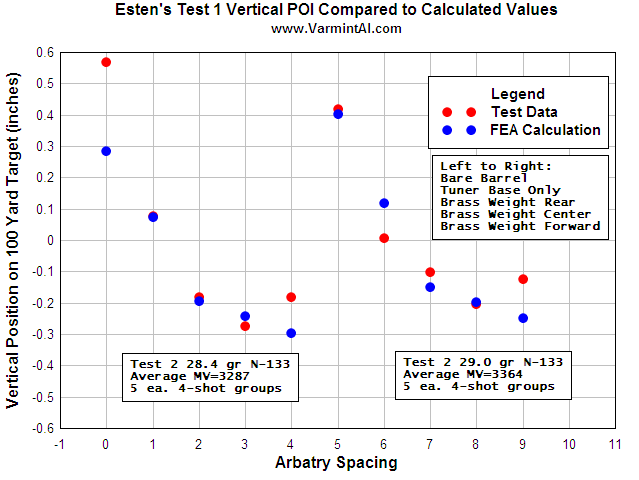
GRAPHICAL COMPARISON.... This is the same data as the above Table with
the average Test POI values plotted along with the Calculated POI values. The
POI values of each set were shifted vertically for an average of zero. This was
done so one may more easily compare the calculated results against the test
data. In essence, it is the best way I could set the FEA's scope to the same
"zero" as that of Esten's rifle.
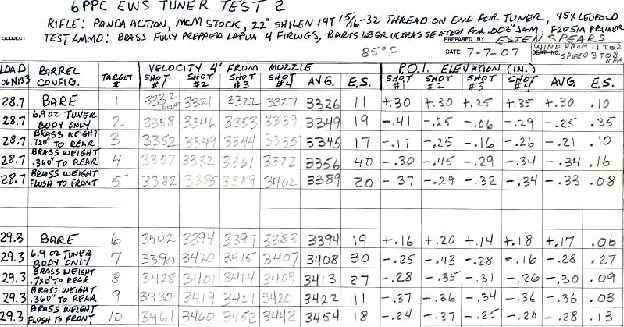
TEST DATA 2.... The firing order (1, 6, 2, 7,...etc.) on this test was
28.7 gr N-133 Bare group then 29.3 gr N-133 Bare group. It was easier to switch
loads than to change the tuner setup for each group.
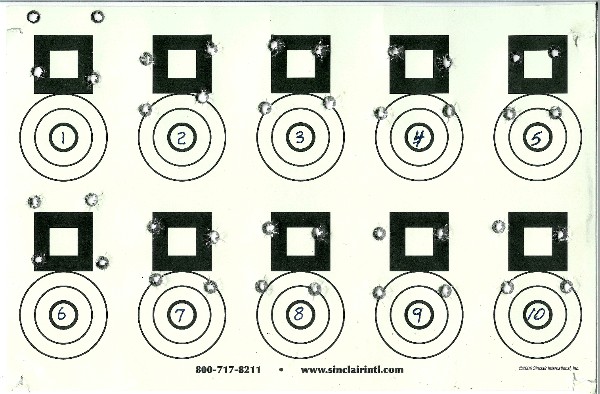
TEST TARGET 2.... Before the test Esten raised the scope setting by
1/2". The scope was NOT adjusted after that. The same aim points were used
as in Test 1.
Table: Test 2 Data POI Summary and Comparison to Calculated POI
| Barrel Condition | Average Muzzle Velocity (fps) |
Average Measured Point of Impact (in) |
Test POI Shifted for Average of Zero (+0.188)* |
Calculated POI Shifter for Average of Zero (+2.1951)** |
| Bare Barrel | 3349
28.7 gr N-133 |
+0.30 | 0.488 | 0.3502 |
| Tuner Base | -0.25 | -0.062 | 0.1224 | |
| Tuner Base + Weight (rear) | -0.21 | -0.022 | -0.1582 | |
| Tuner Base + Weight (center) | -0.34 | -0.152 | -0.1995 | |
| Tuner Base + Weight (forward) | -0.33 | -0.142 | -0.2354 | |
| Bare Barrel | 3418
29.3 gr N-133 |
+0.17 | 0.358 | 0.4431 |
| Tuner Base | -0.28 | -0.092 | 0.1591 | |
| Tuner Base + Weight (rear) | -0.30 | -0.112 | -0.1238 | |
| Tuner Base + Weight (center) | -0.36 | -0.172 | -0.153 | |
| Tuner Base + Weight (forward) | -0.28 | -0.092 | -0.2049 |
* Each Test POI has 0.188 added to make the average POI = 0.0
**Each calculated POI has 2.1951 added to make the average POI = 0.0
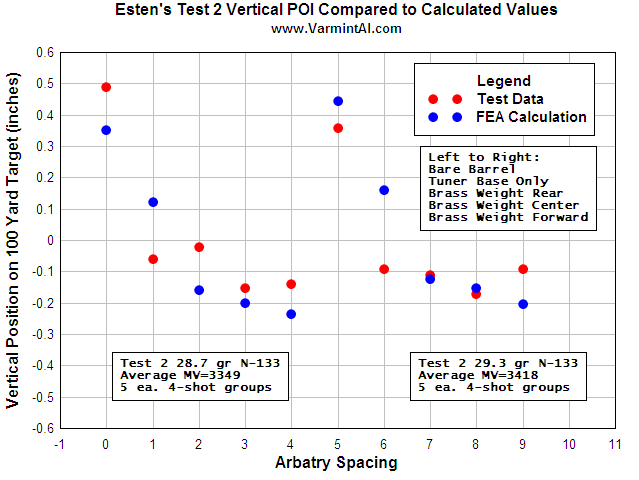
GRAPHICAL COMPARISON.... This is the same data as the Table above with
the average Test POI values plotted along with the Calculated POI values. The
POI values of each set were shifted vertically for an average of zero. This was
done so one may more easily compare the calculated results against the test
data. In essence, it is the best way I could set the FEA's scope to the same
"zero" as that of Esten's rifle.
For each calculated shot's Point of Impact (POI), the following was
calculated:
1. Muzzle's projection to the 100 Yd Target
2. Muzzle's vertical velocity transmitted to the bullet at exit
3. Time of Flight (TOF)
4. Drop during the flight to the target (ballistics)
5. Bullet's vertical displacement from 2. during the TOF
6. Pressure curve scaled for the correct Muzzle Velocity
7. Bullet exit time
Note. Not only is the muzzle exit angle changing in time, but the muzzle is also
moving in the vertical direction while the bullet is traveling down the barrel.
When the bullet exits the muzzle the bullet will have the same vertical velocity
as the muzzle. This vertical velocity during the TOF will also effect the
vertical placement of the impact at the target.
FEA Calculation Including Sandbags & a Bullet in The Barrel

The bullet has the pressure on its base. The deformations are not amplified.
The bullet would be out of the picture in one frame if the deformations were
amplified.
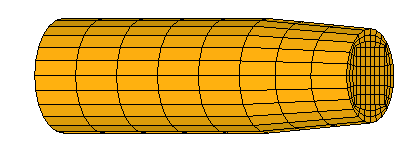
BULLET MESH.... The bullet is a 70 gr 6mm bullet. The ogive is truncated
to simplify the mesh. The bearing surface is correct and the friction between
the bullet (static = 0.2 dynamic=0.17). There is a 0.0005 inch clearance around
the bullet before it enters the 6mm bore diameter. The barrel is smooth bore.
There is no rifling in the barrel. The inclusion of rifling would require a full
3-D model which is very complex.
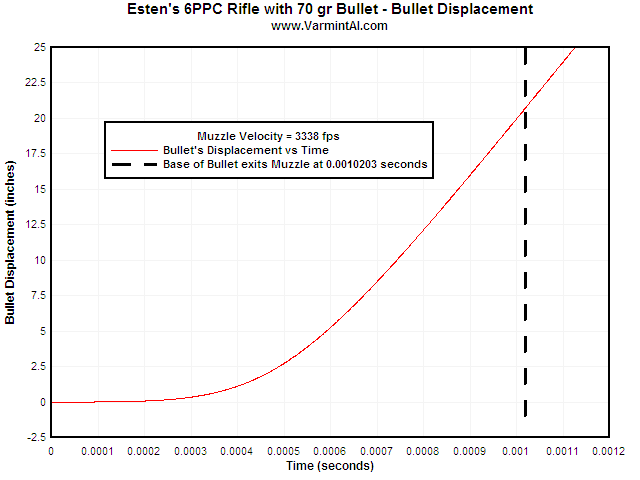
BULLET DISPLACEMENT.... The base of the bullet exits the muzzle at
0.0010203 seconds with a velocity of 3338 fps. After the bullet exits the muzzle
the pressure on its base is reduced to zero in 0.000001 second.
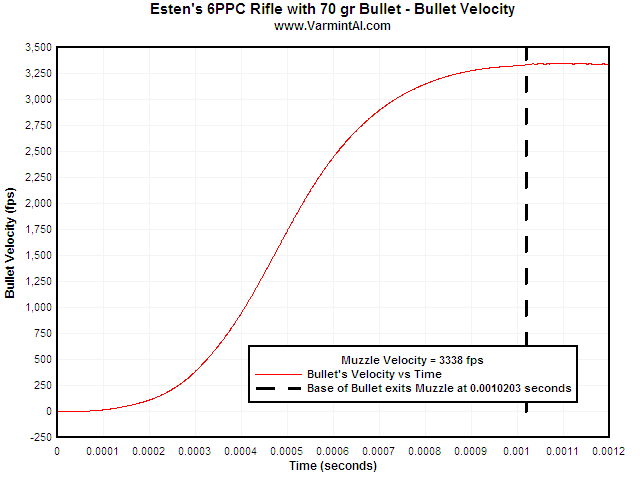
BULLET VELOCITY.... The bullet achieves a muzzle velocity of 3338 fps as
the base exits the muzzle. The bullet is in contact with the bore and the
contact surfaces between the bullet and bore constrain it vertical position to
that of the barrel's bore.
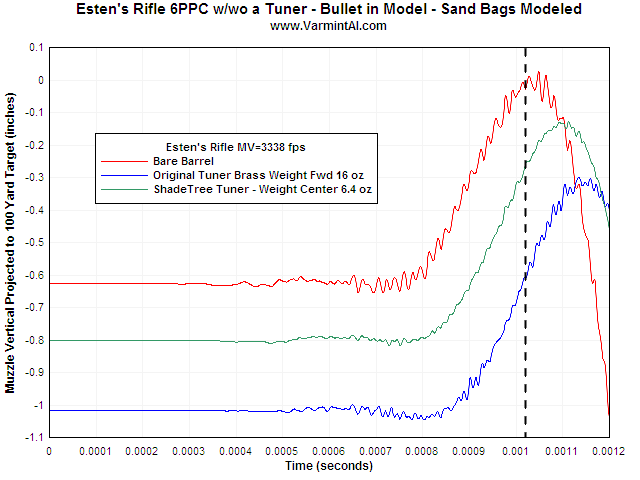
MUZZLE PROJECTION CURVES.... The inclusion of the sandbag rests and the
bullet only slightly changes the Muzzle Projection Curves from the earlier
calculations. Esten's original tuner with the weight forward puts the muzzle
exit time near the center of the upward slope. Without the tuner and a bare
barrel there is no compensation for small variations in muzzle velocity. For
comparison, I also included Esten's Rifle model with the ShadeTree tuner with
the weights centered.
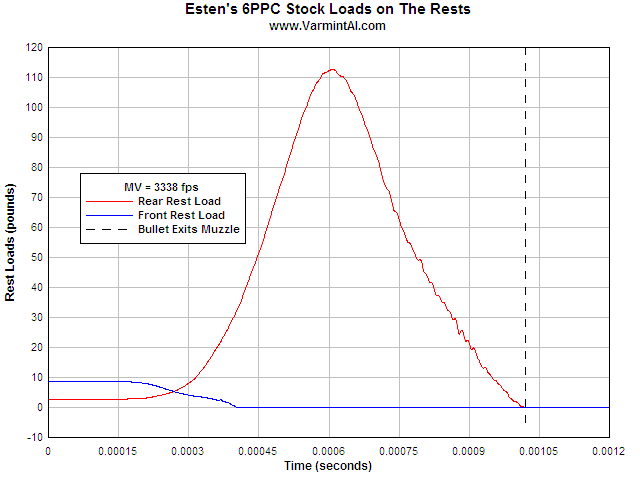
LOAD ON THE SAND BAGS.... Here is the calculation of how Esten's Rifle,
with the bare barrel, loads the sand bags when it is fired. When gravity is
applied the full weight is on the sand bags. The load on the forearm is more
because the CG is closer to the forward sand bag. The loads decrease to zero as
the bullet moves and the rifle starts to recoil. Then the buttstock is forced
down on the rear sand bag with about 112 pounds as the rifle rotates around the
CG. All this time the forearm is rising and when the bullet exits the muzzle,
the rifle is not loading the sand bags at all. The forearm is about 0.0012
inches above the front rest at bullet exit time. I have felt my rifles jump when
I fire them, but never thought that it could be completely off the sand bags
when the bullet exits. The calculation is free recoil. No shooter's shoulder
pressure.
Effect of Powder Selection on Barrel Motion
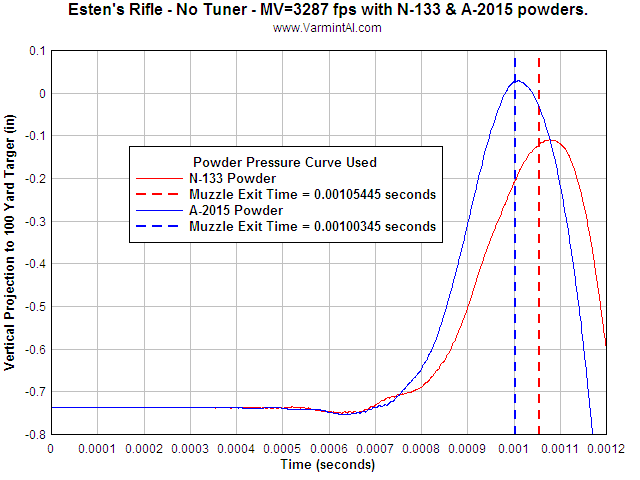
DIFFERENT POWDERS.... This chart shows that A-2015 powder with different
burning characteristics causes the bullet to exit earlier, but the Muzzle
Projection Curve is increased in amplitude and the muzzle exit time is nearly at
the same location with respect to the peak of the curve.
Front Rest Placement and POI Change
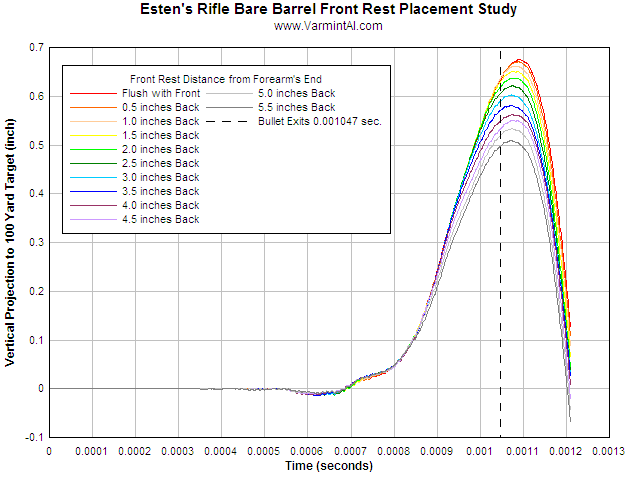
FRONT REST PLACEMENT.... I ran a number of cases with the FEA model of
Esten's Rifle and the only change for each calculation was the position of the
front rest. The first calculation had the front edge of the rest flush with the
end of the forearm. A new calculations was done for each 1/2 inch position as
the front rest was moved aft. The front rest was the width of the forearm and
the longitudinal support length was two inches. The muzzle velocity of each
calculation was 3326 fps with the N-133 pressure curve and the bullet exit time
was 0.001047 seconds.
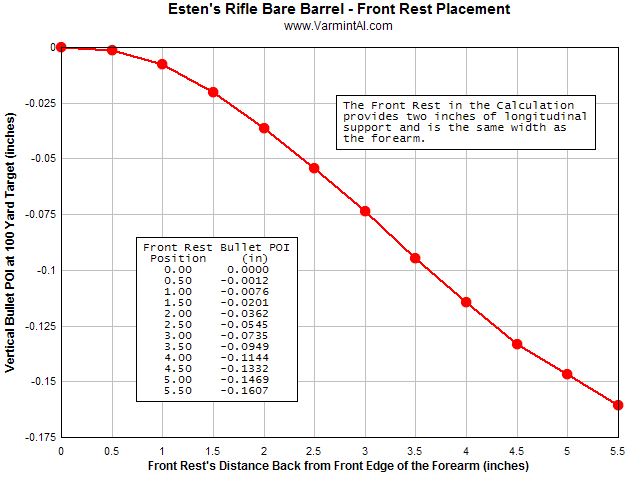
CHANGE IN POI.... With perfect bullets, a perfect hold, the same 3326 fps
velocity, and the same N-133 pressure curve the Point of Impact (POI) at the 100
yard target dropped as the front rest was moved closer to the action. At 2
inches back from the end of the forearm, a position change of 1/2 inch of the
front rest would result a vertical spread of approximately 0.018 inches. However
going from flush with the front of the forearm to moving the front rest back 5.5
inches would result in a vertical spread of about 0.160 inches. The vertical POI
was zeroed with the front rest flush with the front of the forearm.
For the POI of each front rest placement the following was calculated:
1. Pressure curve scaled for the correct Muzzle Velocity (N-133 MV=3326 same for
each shot)
2. Bullet exit time (0.001047 seconds same for each shot)
3. Drop during the flight to the target (1.6487 inches same for each shot)
4. Muzzle vertical velocity transmitted to the bullet at exit (Ranged from
-0.79673 to -0.97325 in/sec)
5. Time of Flight (TOF) (0.09496 seconds same for each shot)
6. Bullet vertical displacement from 4. during the TOF Ranged from -1.0745 to
-1.2352 inches)
7. Muzzle's Projection to the 100 Yard Target vs time (See the chart)
Muzzle Projection Curve and Muzzle Exit Time
Improving accuracy by compensating for small variations in muzzle velocity.
Smaller Groups Left of the Peak - UPWARD SLOPE:
Higher velocity shots exit early while pointing lower at the target but drop
less in reaching the target.
Lower velocity shots exit later while pointing higher at the target but drop
more in reaching the target.
Counteracting combination. Good.
Larger Groups Right of the Peak - DOWNWARD SLOPE:
Higher velocity shots exit early while pointing higher at the target and drop
less in reaching the target.
Lower velocity shots exit later while pointing lower at the target and drop more
in reaching the target.
Bad additive combination. Bad.
The additional mass of a Muzzle Tuner slows down the muzzle movements and allows
the bullet exit before the peak of the muzzle projection curve during the upward
slope without resorting to high pressure loads.
Some ways to get the muzzle exit time on the Left Side of the Peak
1. Add weight to the muzzle to slow down the muzzle movement
2. High pressure/high velocity load to make the muzzle exit time earlier
3. Faster burning powder to have the bullet gain velocity early and make the
exit time earlier
4. Longer barrel to slow down the muzzle movement
Ladder Test Calculation with Esten's 6PPC Rifle FEA Model
LADDER TEST.... It appears that the "Muzzle Projection Curve" (MPC) plus the Muzzle's Vertical Velocity that is imposed on the bullet at muzzle exit time tends to shed some light on what is going on in the Ladder or "Audette" test. The Ladder Test uses loading to generate a series of loads with increasing velocity shot at the same target to see if some of the rounds print at the same POI even with different velocities. If a convergence is found, then loading in that range of velocity should shoot tight groups even with slight velocity variations. The following calculations were done to find the Point of Impact (POI) at a 100 yard virtual target. In the field, it is typical to shoot the Ladder Test at long range. One thing the 300 yd Ladder Test does it that it amplifies the bullet drop more than where the muzzle is pointing. The muzzle pointing is line-of-sight and therefore linear but the bullet drop during the Time Of Flight (TOF) is not linear with distance. With the calculation it is possible to calculate the POI even if they are close to each other, so 100 yards was used.
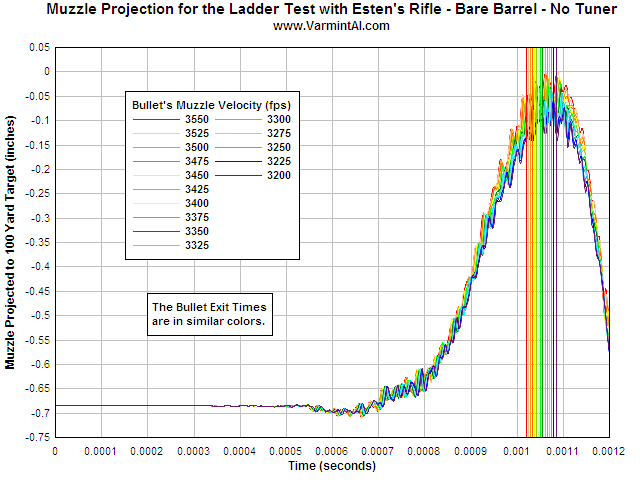
BARE BARREL.... The Muzzle Projection Curves for Esten's 6PPC Rifle with
no tuner show the bullet exit times fall near the left side of the peak for
muzzle velocities ranging from 3200 to 3550 fps.
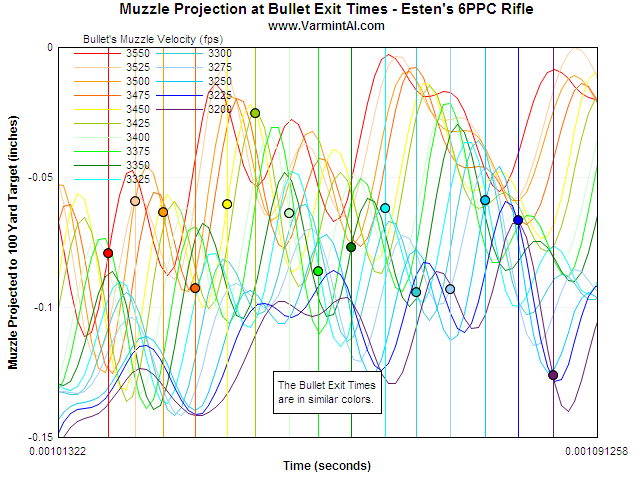
ZOOM ON THE EXIT TIMES.... The intersection points show where the muzzle
is pointing at the 100 yard target at the time of bullet exit for each muzzle
velocity. The high frequency superimposed on the MPC's is excited by the high
pressure gas traveling up the barrel behind the bullet. I picked out the
intersections by hand and then plotted the points to verify that the correct
intersections were selected. I used a similar color code for the curves and the
intersection points. Note that the higher velocity bullets exit point at the 100
yard target about the same place as the lower velocity bullets. But the lower
velocity bullets will drop more on their way to the target.
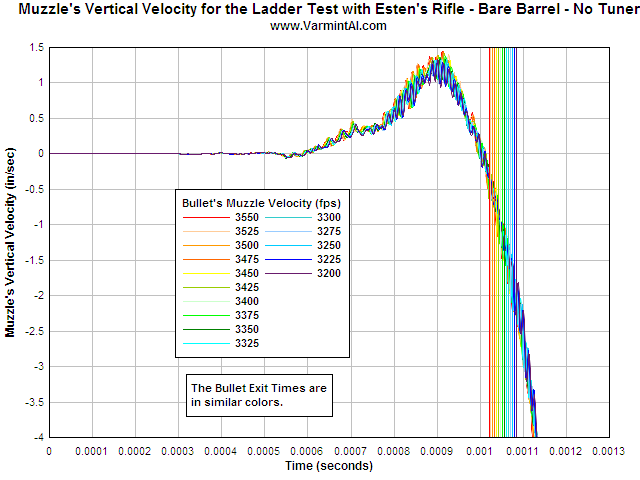
MUZZLE'S VERTICAL VELOCITY.... The muzzle of the barrel is moving
vertical with the velocities shown in the chart. The muzzle imparts this
vertical velocity to the bullet as it exits. This velocity over the Time Of
Flight (TOF) can also cause more drop.
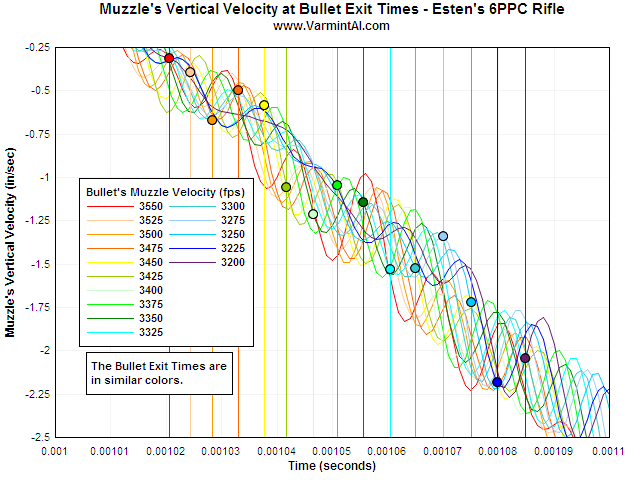
ZOOM MUZZLE'S VELOCITY.... The bullet's vertical velocity was picked by
the intersection of the muzzle's vertical velocity at bullet exit time. Again,
these values were picked by hand and then the points plotted here to verify that
they were selected correctly.
For each calculated shot's POI, the following is calculated:
1. Pressure curve scaled for the correct Muzzle Velocity
2. Bullet exit time
3. Drop during the flight to the target
4. Muzzle vertical velocity transmitted to the bullet at exit
5. Time of Flight (TOF)
6. Bullet vertical displacement from 4. during the TOF
7. Muzzle's projection to the 100 Yd Target at bullet exit time
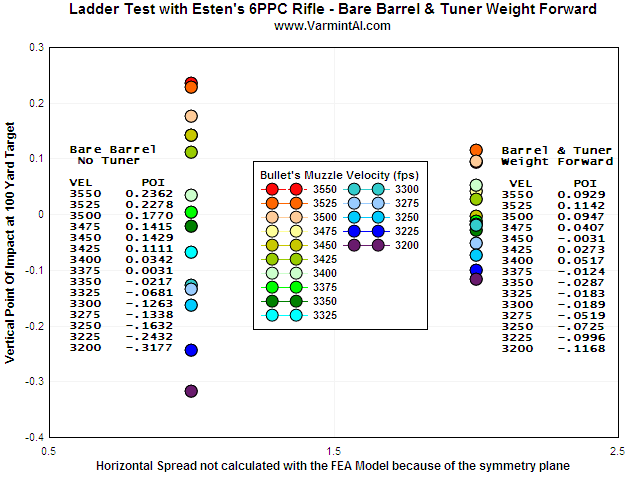
LADDER TEST RESULTS.... The total vertical spread with the bare barrel is
0.5539 inches compared to 0.2097 inches for the case with the tuner and the
weight forward. The chart represents where the bullets would strike at a virtual
100 yard target for the range of velocities listed. For Esten's Rifle with no
tuner, there are three groupings near 3475 fps, 3375 fps, and 3275 fps. These
muzzle velocities could be loads where the rifle is "in tune". The
yellow circle (3475 fps) is under the gray green circle.
However with a tuner and the weight in the forward, the calculation shows groupings near 3525 fps, and 3300 fps. One thing to note is that the total vertical spread for all of the velocities with the tuner is less than half the vertical spread with the bare barrel. It appears that even with a tuner out of tune, one would expect better accuracy than with a bare barrel.
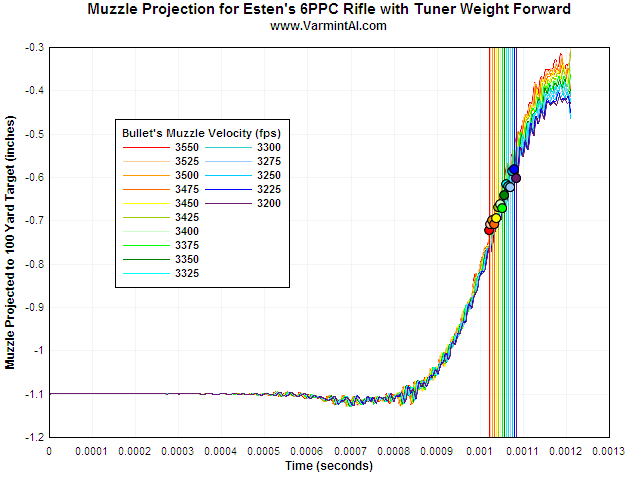
BARREL TUNER.... The smaller vertical spread with the tuner appears to
occur because the bullet's muzzle exit times are on the left side of the MPC. On
the average, the barrel is point higher on the target for slower velocity rounds
that drop more in reaching the target.
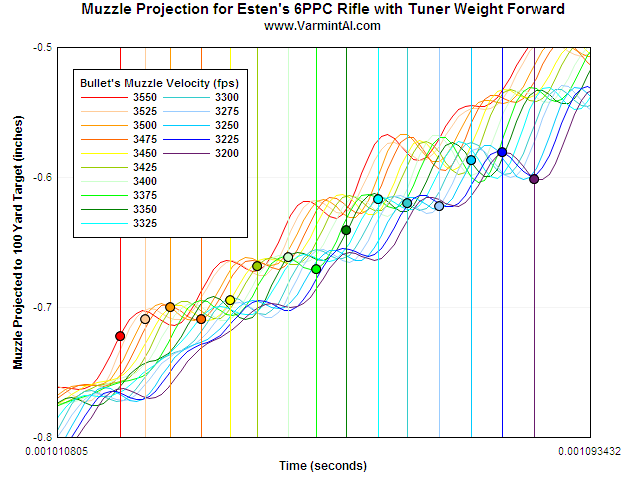
ZOOM.... This chart zooms in on the bullet's muzzle exit times with the
barrel tuner.
ADJUSTING THE TUNER.... One way to adjust
your tuners to minimize the vertical spread. First, trying to remove the
vertical spread, with ammo that is carefully prepared to give consistent
velocity and very little vertical, is difficult. The effects of tuner movement
on vertical spread will be difficult to see. It makes it difficult to tune out
the vertical if there is none.
PREPARE AMMO WITH VERTICAL.... Load ammo WITH a vertical spread built in.
Here is a possible test procedure. Test with 6 shot groups. For example, load 3
rounds with your normal load +0.5 gr of powder and 3 rounds with your normal
load -0.5 gr of powder. This ammo should exhibit vertical spread. Then adjust
your tuner to minimize the vertical spread. Shoot 6 shot groups alternating
between the two loads (one high velocity round then one low velocity round.
etc.). This procedure would amplify the vertical and better show the effect of
the tuner's position on minimizing vertical.
This could be done with the rifle and no tuner to see the magnitude of the
vertical and then later with the tuner to show if the tuner does decrease the
vertical when adjusted correctly.
Mode Shapes and Natural Frequencies
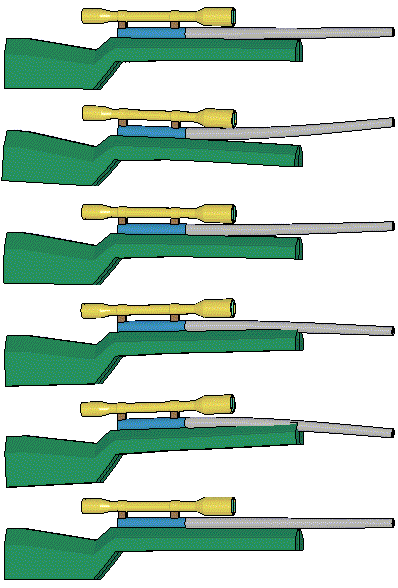 Mode 1 @ 134.5 Hz |
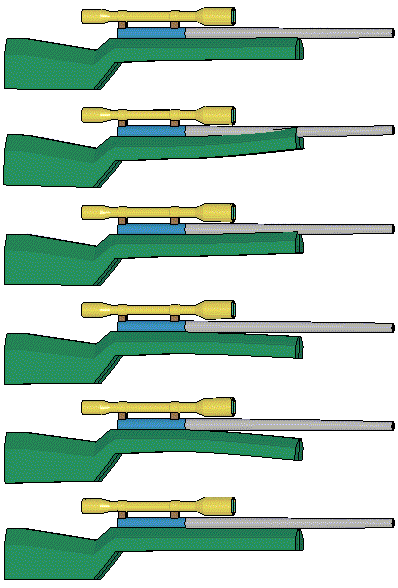 Mode 2 @ 299.0 Hz |
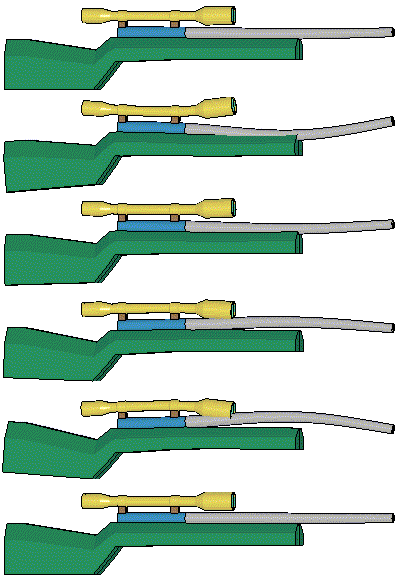 Mode 3 @ 383.6 Hz |
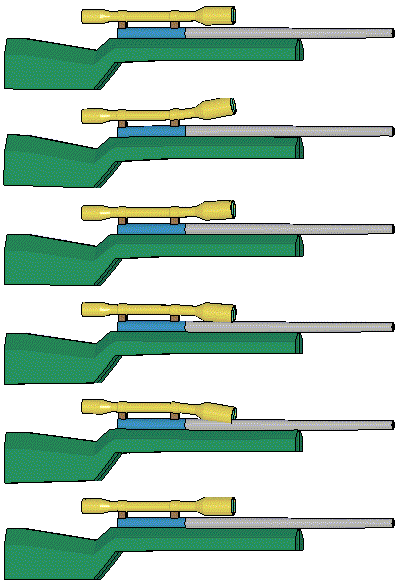 Mode 4 @ 400.5 Hz |
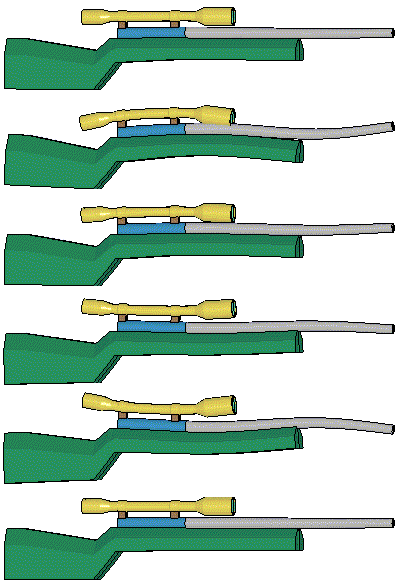 Mode 5 @ 691.3 Hz |
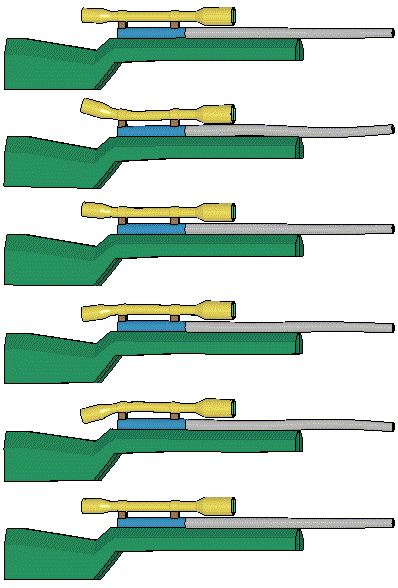 Mode 6 @ 1024 Hz |
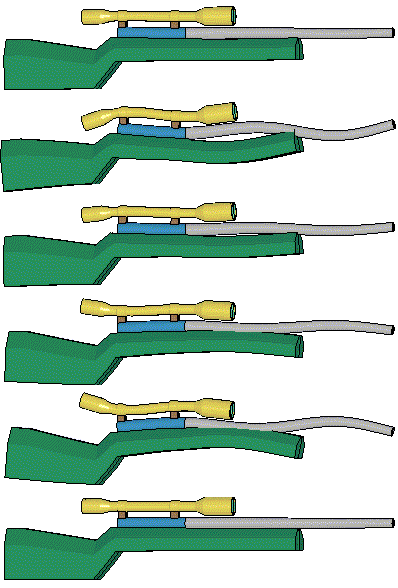 Mode 7 @ 1204 Hz |
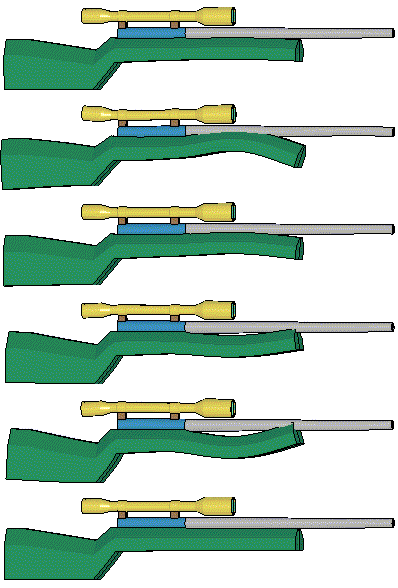 Mode 8 @ 1629 Hz |
FIRST 8 MODES.... Here are the mode shapes and natural frequencies of Esten's Rifle. I only show the first 8 Mode of vibration. The addition of the scope and a more realistic rifle stock added a number of lower natural frequencies and their mode shapes. The boundary conditions are Free-Free. This is as if the rifle were suspended in space with zero gravity.
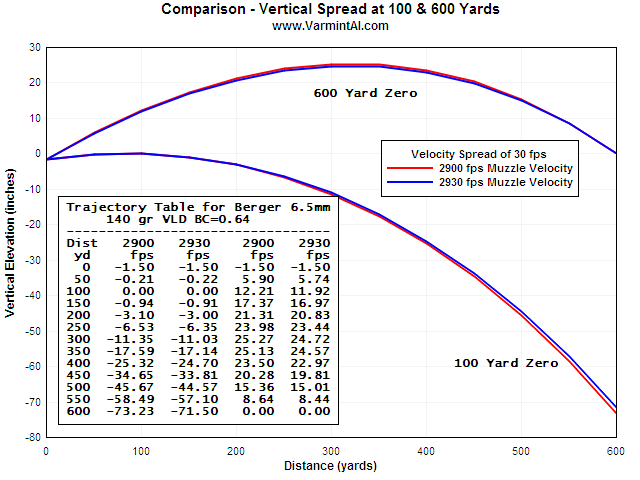
LONG RANGE TUNE.... Here is an interesting set of trajectory plots. No
matter how carefully one loads his ammo, there are going to be small differences
in muzzle velocity. Consider a load with an average muzzle velocity of 2915 fps
with a muzzle velocity variation of 15 fps. Then consider this load tuned for
zero vertical at 100 yards that overcomes that small difference in muzzle
velocity.
This same load will be out of tune by 73.23-71.50=1.73 inches of vertical at 600
yards. However if the load is tuned so that there is 12.21-11.92=0.29 inches of
vertical at 100 yards (with the slower muzzle velocity hitting higher)
then there would be zero vertical at 600 yards. This chart is for a 6.5mm 140 gr
VLD bullet with a 0.64 BC. A similar chart or table can be made for each long
range load. If you are in tune for zero vertical at 100 yards, you will not be
in tune for zero vertical at 600 or 1000 yards.
"Bong Test!" Tapping a barrel to fine a node.
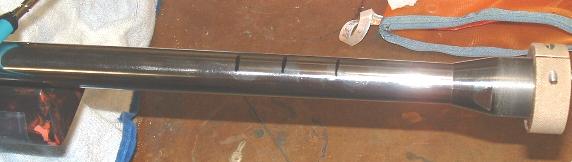
BONG TEST RESULTS.... Esten performed the "Bong Test!" on his
6PPC benchrest rifle and was able to find the node locations for three different
conditions. I used the FEA model of Esten's rifle to calculate the mode
frequency and node location for the conditions that Esten tested. Possibly
positive compensation would occur if the node were moved to the muzzle. The
highest angular variations occur at the node. The anti-nodes are the only
locations where the barrel stays parallel to the axis and there is no angular
displacement. The calculated results are compared to the test results and listed
below. For the modal analysis the FEA model boundary condition was free-free.
That is as if the rifle were suspended in zero gravity.
THE CONDITIONS....
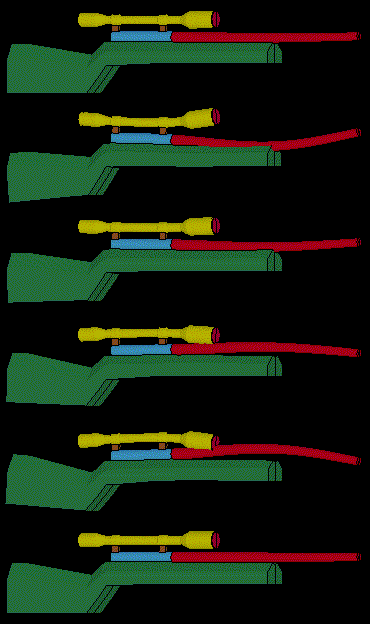
Bare Barrel. Calculated/Test
Node location back from the muzzle (in): 5.28/5.75
Mode Frequency (Hz): 383.5/Not Recorded
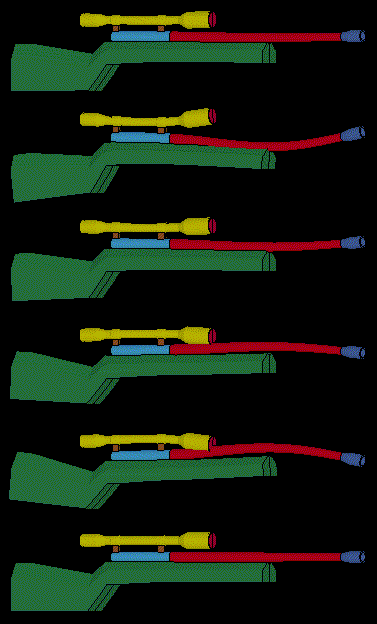
Barrel with only the Tuner Base attached. Calculated/Test
Node location back from the muzzle (in): 3.45/4.75
Mode Frequency (Hz): 344.5/Not Recorded
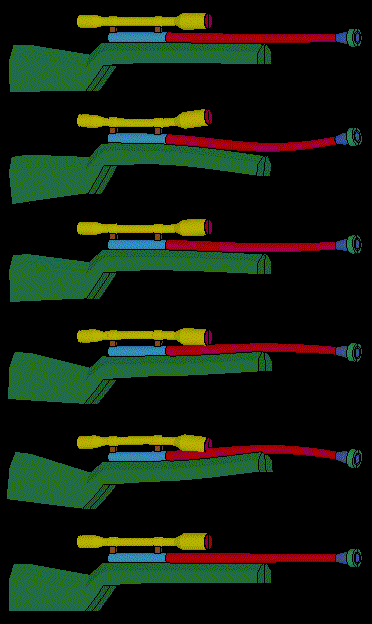
Barrel with the Tuner Base and the Weight in the forward position.
Calculated/Test
Node location back from the muzzle (in): 2.20/3.62
Mode Frequency (Hz): 326.6/315.0
The "Bong Test" convinced Esten that the node could not be moved to the muzzle on a Standard Taper Centerfire Barrel within the weight constraints of NBRSA LV or HV. Here is a humorous article about a Bong Test. Note: This is from TheWayBackMachine without pictures.
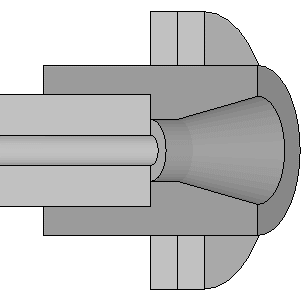
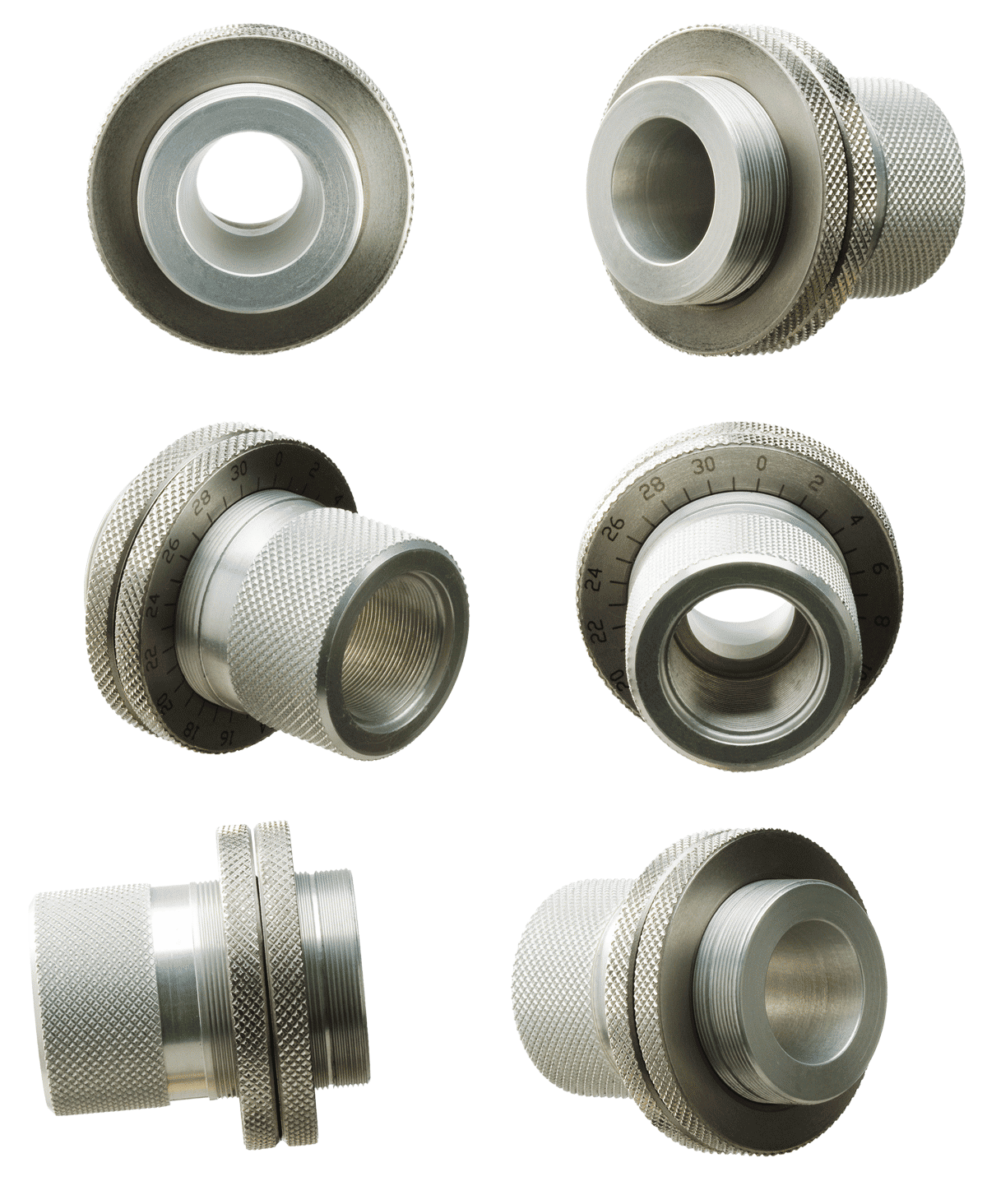
ON A FINAL NOTE.... These guys are building an improved version of Esten's Tuner. Here is the link: ShadeTree Engineering & Accuracy Selling the Improved Esten Tuner.
Good Hunting... from Varmint Al
For the serious reader: How to Check
Another Engineer's Calculation.
Last Updated: 07/19/2015
End of Page